
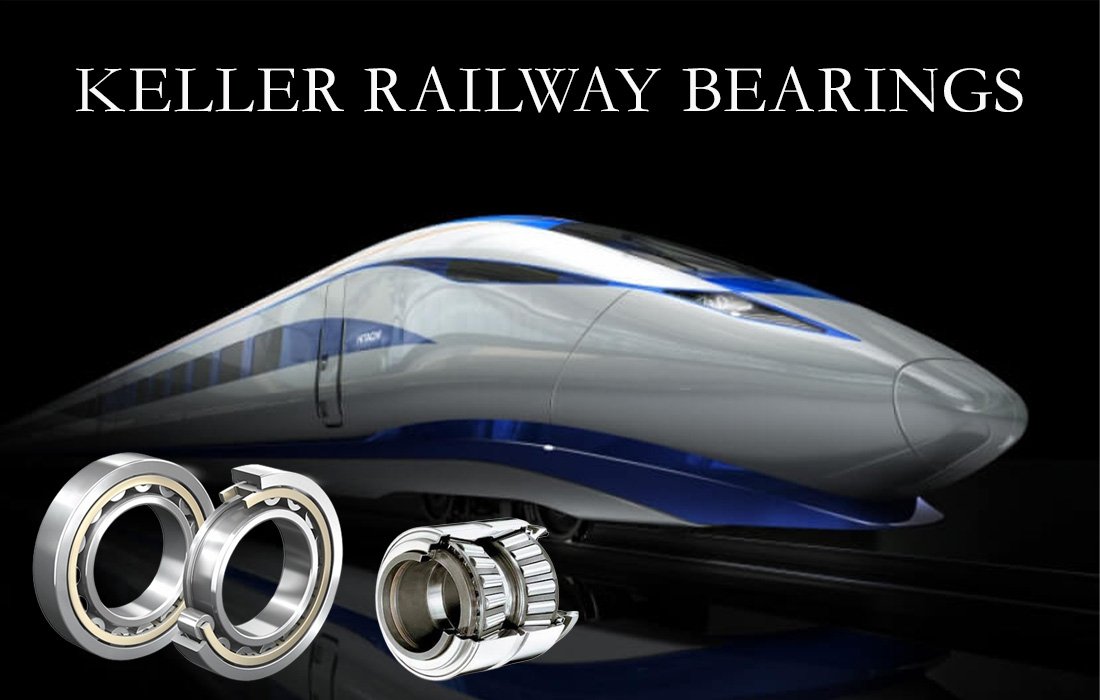
Are railway bearing models interchangeable? The answer cannot simply be “yes” or “no.” Different brands may offer bearing models with similar dimensions; however, identical dimensions do not guarantee identical performance. Therefore, purchasers must conduct a comprehensive comparison of specifications.
Railway vehicles place high demands on bearings, as these components are critical to the operation of axles, wheelsets, and bogies. Consequently, substituting bearing models requires extra caution.
1. Identical dimensions do not imply interchangeability
First, it is necessary to verify the bearing’s inner diameter, outer diameter, and width. These three dimensions must meet installation requirements.The inner diameter must match the axle, the outer diameter must fit the axle box or bearing housing, and the width must suit the available installation space.
However, even if these three dimensions match, differences may still exist between bearings. Therefore, purchasers should not base substitution decisions solely on dimensions.
2. Bearing structure must be verified
Next, the bearing structures must be compared. Different structures affect axial positioning and load-carrying capacity.
For instance, cylindrical roller bearings come in various configurations, such as NU, NJ, and NUP, each offering a different method of axial positioning.Therefore, purchasers must verify the structure of the original bearing. If the structures do not match, the bearing may not install or operate correctly in the vehicle.
3. Load ratings must be compared
Railway vehicles generate significant loads during operation. Thus, a replacement bearing must meet the load-bearing requirements of the original product.Purchasers should compare the dynamic load rating (C) and the static load rating (C₀).
If the replacement product lacks sufficient load capacity, the bearing’s service life could be compromised.Load parameters require special attention, particularly for heavy-haul freight cars and locomotives.
4. Rotational speed must be compared
High-speed trains place strict demands on bearing rotational speeds. Therefore, a replacement model must be capable of handling the actual operating speed.
High-speed rotation generates heat and increases friction.Consequently, purchasers need to compare limiting speeds and reference speeds, as well as verify the lubrication method.If a replacement bearing cannot withstand high-speed operating conditions, it is unsuitable for direct use.
5. Internal clearance and precision must be verified
Bearing internal clearance affects temperature, vibration, and operational stability. Common clearance classes include CN and C3. Therefore, the replacement model must meet the original bearing’s internal clearance requirements.Precision class is also critical. High-speed rail applications typically demand higher rotational precision.Consequently, purchasers need to compare precision classes such as P0, P6, and P5.
6. Comparison of sealing and lubrication
Railway vehicles operate in complex environments over long periods. Therefore, bearings require excellent sealing performance.Different models may utilize different sealing configurations; purchasers should verify the sealing method of the original bearing.
Additionally, the lubricant must be compatible with the bearing’s operating conditions. High-speed trains and standard freight wagons may require different lubrication strategies.
7. What information is needed for railway bearing interchangeability?
Overseas purchasers can provide the original bearing model number, allowing suppliers to quickly verify product details.If the full model number is unavailable, bearing dimensions and product photographs can be provided instead.It is also advisable to provide details regarding the vehicle type, installation position, operating speed, and load.Suppliers can use this information to cross-reference models and compare technical specifications across different brands.
When is interchangeability an option?
If two models share the same dimensions and structure—and also match in terms of load, rotational speed, internal clearance, precision, and sealing requirements—then the replacement option can be further evaluated.However, railway vehicles are high-reliability applications. Therefore, purchasers must also conduct technical verification and practical testing.Railway bearings should not be replaced simply because the model numbers appear similar.
Conclusion
Not all railway bearing models are directly interchangeable. First, dimensions must be verified. Second, structure and load ratings must be compared.
At the same time, requirements for rotational speed, internal clearance, precision, sealing, and lubrication must be checked.Therefore, professional model replacement requires a comprehensive analysis. For overseas purchasers, providing complete bearing specifications helps suppliers quickly identify suitable replacement models.


