
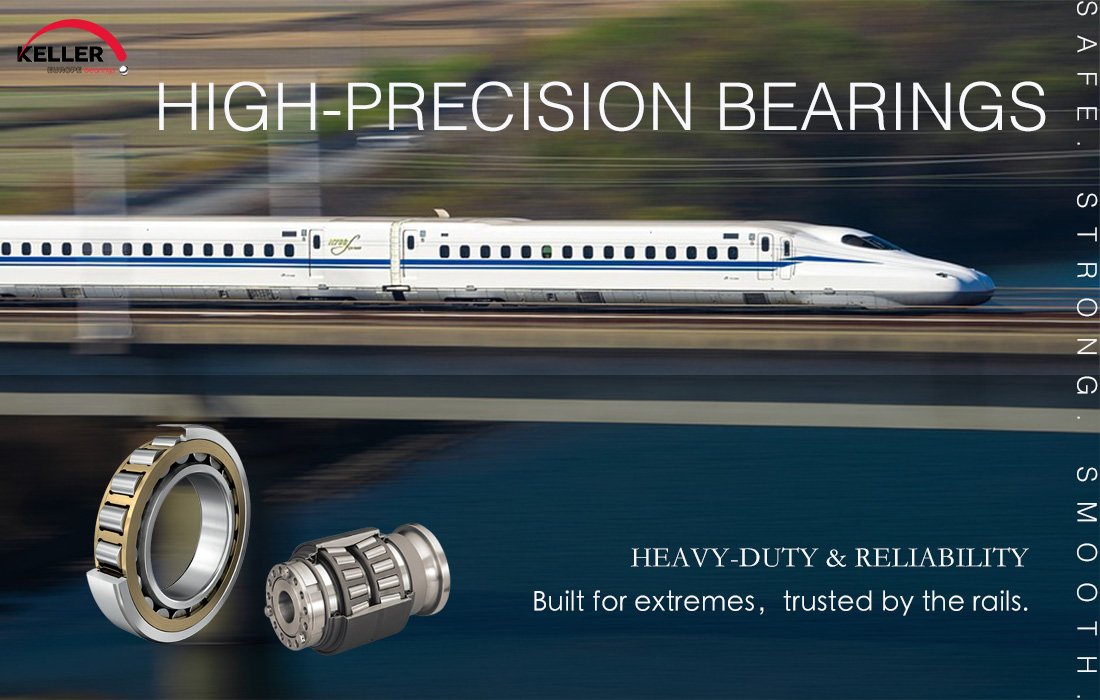
Sealed railway bearing units are vital components of the running gear in railway vehicles. They primarily handle tasks such as axle rotation, load transmission, and operational support.
Railway vehicles operate for extended periods, subjecting bearing units to continuous radial and axial loads. Additionally, the vehicles generate vibrations and shocks. Consequently, sealed railway bearing units must maintain stable operational performance.
The sealing structure is a crucial feature of these bearings. Effective sealing minimizes the ingress of dust, moisture, and other contaminants into the bearing interior while helping to maintain optimal lubrication.
Primary Functions of Sealed Railway Bearing Units
Sealed railway bearing units connect the axle to the axle box structure, supporting the stable rotation of the wheels and axle.The bearings utilize a rolling element design. Rolling elements reduce friction during rotation, while an optimized bearing structure minimizes operational resistance.
As railway vehicle speeds increase, bearings must withstand higher rotational speeds. Simultaneously, the vehicle’s weight generates significant operational loads.Stable bearing operation helps reduce vibration and noise, as well as heat generated by friction.
Structural Characteristics of Sealed Railway Bearing Units
Sealed railway bearing units typically consist of an inner ring, an outer ring, rolling elements, a cage, and a sealing structure.The inner ring mates with the axle, while the outer ring connects to the axle box. Rolling elements bear the primary load, and the cage maintains the positioning of the rolling elements.
Sealing systems are located on both sides of the bearing to block external contaminants; different operating environments require specific seal designs.
Some railway bearing units employ an integrated structure, which simplifies installation and facilitates vehicle maintenance.
Importance of Sealing Performance
Railway vehicles operate in complex environments where dust, rain, and moisture may be present in the track area.Contaminants entering the bearing can compromise lubrication and increase internal wear.
Sealing structures mitigate the impact of the external environment; an effective seal design helps keep the bearing interior clean.
Sealed railway bearing units must also maintain good lubrication performance. Proper lubrication reduces friction and helps control operating temperatures.
Performance Requirements for Sealed Railway Bearing Units
Railway bearings require high load-bearing capacity and must adapt to varying speed and temperature conditions. Material properties influence a bearing’s wear resistance and operational stability, while machining precision affects the quality of the fit.
Bearing dimensions are equally critical; the inner diameter, outer diameter, and width must comply with the vehicle’s installation requirements.
Selection also requires consideration of axle load, rotational speed, operating environment, and lubrication method. Properly matching these parameters enhances the bearing’s operational efficiency.
Applications of Railway Sealed Bearing Units
Railway sealed bearing units are used in electric multiple units (EMUs), high-speed trains, passenger trains, and other railway rolling stock.Different vehicles have varying axle loads and operating speeds; therefore, bearing units must be selected based on specific vehicle parameters.
For high-speed rail vehicles, bearings must maintain stable performance during high-speed rotation. For vehicles in long-term service, sealing performance and durability are equally important.
International railway projects typically focus on product dimensions, materials, loads, and technical specifications. Comprehensive product information enables procurement personnel to select the right product quickly.
Conclusion
Railway sealed bearing units play a vital role in rotation and load transmission. Their sealing structure minimizes the impact of external contaminants on the bearing’s internal components.
Applications in railway vehicles require a comprehensive assessment of dimensions, loads, rotational speeds, lubrication, and operating environments.
Proper selection of railway sealed bearing units ensures that the operational needs of railway vehicles are effectively met. Clear technical specifications also help international customers streamline the selection process.


