
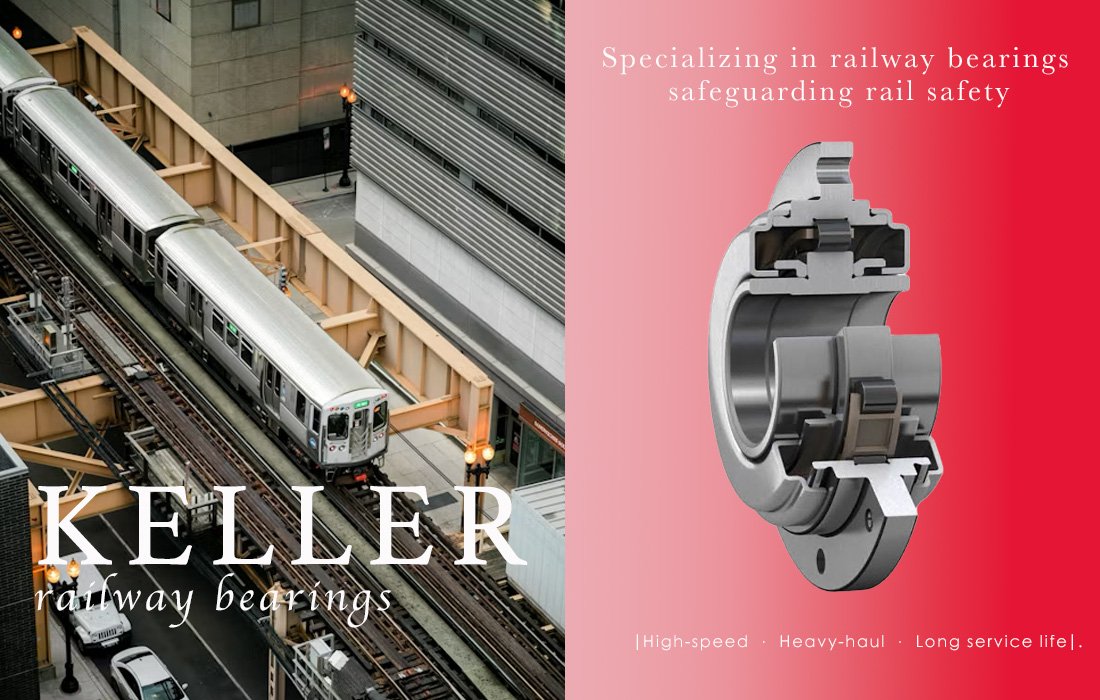
Railway bearings support significant loads from axles, wheelsets, and drive systems. They must withstand high-speed operation, heavy-load impacts, and complex environmental conditions. Different types of railway vehicles have specific requirements for bearing models; selecting the appropriate model enhances operational stability and service life.
Railway bearing model designations typically convey information regarding structure, dimensions, and performance characteristics. Common types include cylindrical roller bearings, tapered roller bearings, and deep-groove ball bearings. Some products feature a double-row configuration, a design that enables the bearing to withstand higher radial loads.
Key Railway Bearing Specifications
Key specifications for railway bearings include inner diameter, outer diameter, width, rolling element dimensions, load ratings, and limiting speeds. These parameters vary significantly across different models.
Inner diameter (d): Refers to the bore diameter of the inner ring; this parameter must match the axle dimensions.
Outer diameter (D): Refers to the diameter of the outer ring; this affects the installation space within the axle box.
Width (B): Refers to the axial dimension of the bearing; this influences the overall installation configuration.
Basic dynamic load rating (C): Used to assess the bearing’s dynamic load-carrying capacity; a higher value generally indicates a greater capacity to withstand loads.
Basic static load rating (C₀): Used to assess load-carrying capacity under static or low-speed conditions.
Limiting speed: Indicates the maximum reference speed at which the bearing can operate; actual operating speeds must be determined by considering lubrication, temperature, and load conditions.
Contact angle: Influences the bearing’s radial and axial load-carrying capacities; different structural designs must be matched to specific loading conditions.
Railway Bearing Model Selection
The selection of railway bearing models depends on the vehicle type. High-speed electric multiple units (EMUs) prioritize high-speed performance and low temperature rise. Locomotive bearings must withstand substantial loads and impacts. Freight car bearings prioritize heavy-load capacity and long-term operational stability.
Axle box bearings are commonly used in railway vehicles, interfacing directly with the axle and the axle box. These bearings require high rotational precision, and their sealing structures must withstand dust, moisture, and temperature fluctuations.
Gearbox bearings are used in power transmission systems, requiring the ability to handle high-speed rotation and continuous loads. Traction motor bearings require specific attention to rotational speed, temperature rise, and electrical insulation performance. Railway Bearing Dimensions and Performance
Railway bearing dimensions must meet installation space requirements. The inner diameter requires a proper fit with the axle, while the outer diameter must match the axle box housing. The axial width must also comply with installation specifications.
Railway operating environments involve significant vibration and shock. Bearings must maintain stable internal clearance; appropriate clearance helps minimize temperature rise during operation, while a suitable lubrication strategy reduces friction and wear.
Different applications require specific cages, seals, and greases. High-temperature environments necessitate materials with good heat resistance, whereas cold regions require reliable low-temperature startup performance. High-speed operations demand high rotational precision and superior lubrication performance.
Railway Bearing Applications
Railway bearings are widely used in high-speed trains, electric multiple units (EMUs), subway cars, urban rail vehicles, locomotives, and freight wagons. They are utilized in systems such as axle boxes, gearboxes, and traction motors.
When selecting railway bearings, factors such as model, dimensions, load, rotational speed, and operating environment must be considered. Proper selection ensures stable vehicle operation and reduces maintenance frequency.
To determine specific bearing models and parameters, selection should be based on shaft diameter, outer diameter, width, load, and rotational speed. Different standards and vehicle platforms may utilize different models; it is advisable to verify complete technical specifications and installation requirements prior to procurement.


