
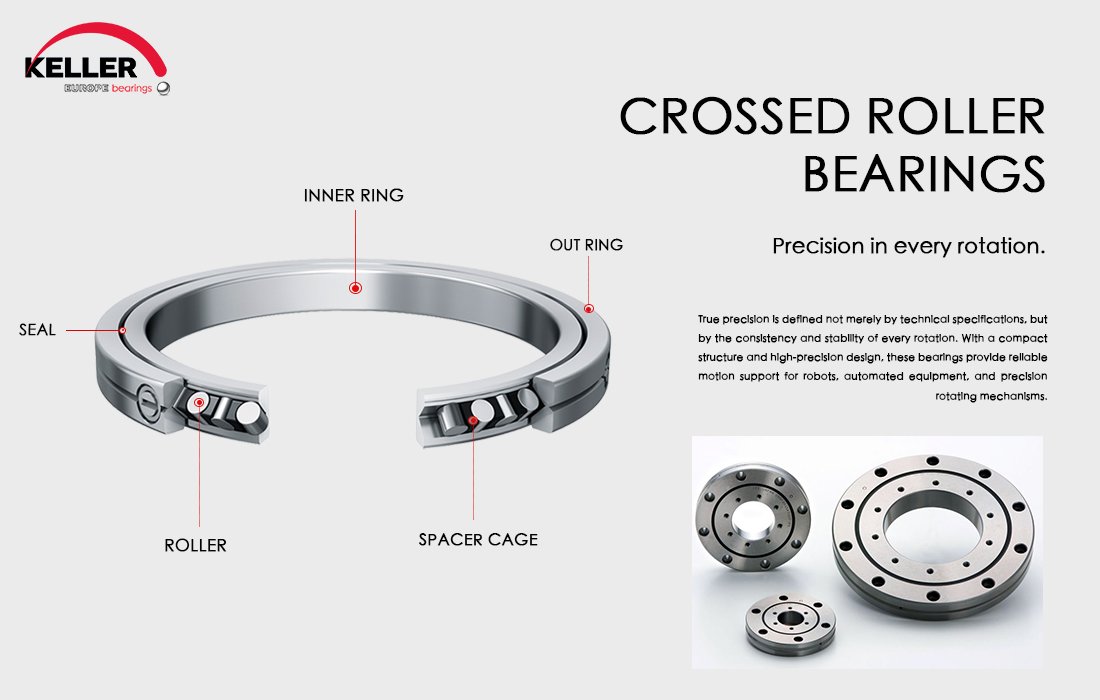
As robotics and precision automation technologies continue to evolve, there is an increasing demand for higher rotational accuracy, structural rigidity, and efficient space utilization in equipment. With their unique roller arrangement and compact design, crossed roller bearings have become a vital component in precision rotating mechanisms.
What Are Crossed Roller Bearings?
Crossed roller bearings feature a design in which cylindrical rollers are arranged in an alternating, crisscrossed pattern. Adjacent rollers are typically oriented at approximately 90° to one another, allowing the bearing to simultaneously support radial loads, axial loads, and overturning moments. Consequently, they are exceptionally well-suited for precision mechanical systems that require multi-directional load-bearing capabilities.
Key Advantages of Crossed Roller Bearings
Crossed roller bearings offer high rigidity and excellent rotational accuracy. Their compact structure enables engineers to simplify support layouts and conserve internal space within equipment. Furthermore, an appropriate preload design helps minimize internal clearance and enhances motion stability. Engineers must, however, determine the optimal preload based on specific load, rotational speed, and lubrication conditions.
Applications in Robotics
Industrial robots, collaborative robots (cobots), and precision robotic arms all require stable joint movement. Crossed roller bearings can withstand the multi-directional loads generated during joint articulation while helping to control structural deformation. Moreover, selecting the right bearing improves the rotational accuracy of joints, meeting the stringent requirements for repeatable positioning and long-term operational reliability in robotics.
Applications in Medical Equipment
Surgical robots require flexible joint structures and precise motion control. Crossed roller bearings provide essential support for components such as wrist joints and other precision rotating assemblies. Additionally, they are frequently utilized in high-precision diagnostic equipment and rotary positioning mechanisms, where specific load and accuracy requirements must be met.
Selecting the Right Bearing
When selecting a bearing, engineers should carefully evaluate factors such as load, rotational accuracy, available installation space, preload, and service life. Proper installation fits and an effective lubrication strategy are also crucial for ensuring the bearing maintains consistent, stable performance.
Conclusion
With their high rigidity, multi-directional load-bearing capacity, and precise rotational performance, crossed roller bearings offer a reliable design solution for robotics, medical equipment, and various automation systems. Through appropriate selection and structural optimization, engineers can further enhance the operational precision and overall performance of equipment.


