
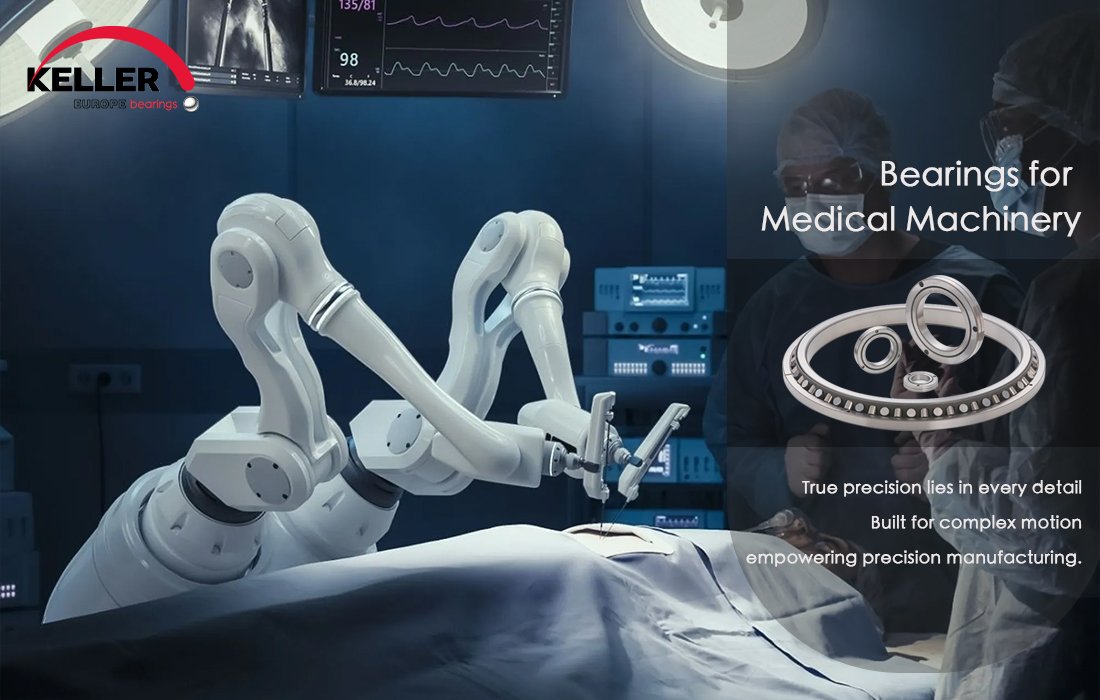
In modern high-end medical machinery and precision medical equipment, thin-section bearings and crossed-roller bearings serve as core supporting components, enabling the miniaturization, weight reduction, high rigidity, and high rotational precision of such devices.
I. Key Application Scenarios for These Two Types of Precision Bearings in Medical Equipment
1. Large-Scale Medical Imaging Equipment (CT Scanners, MRI Systems, C-arm X-ray Machines)
Primarily used: Large-diameter thin-section bearings and large-sized crossed-roller bearings.
Application Analysis:
The gantry of a CT scanner typically has a diameter of 1 to 1.5 meters or more; it must accommodate the human body while rotating continuously at high speeds with smooth, stable motion.
Thin-section bearings (such as the KB/KC series four-point contact ball bearings from Kaydon/RBC) are ideal for addressing space constraints and weight concerns, thanks to their extremely low cross-sectional height and large inner diameter.
Crossed-roller bearings can withstand significant overturning moments, ensuring that the X-ray source and detector do not undergo any mechanical micro-deformation during rotation—thereby preventing the formation of artifacts in medical images.
2. Minimally Invasive Surgical Robots and Medical Robotic Arms (e.g., orthopedic surgical robots, laparoscopic-assisted systems)
Primarily used: Miniature crossed-roller bearings and constant-section thin-wall angular contact bearings.
Application Analysis:
The joints of surgical robotic arms require operational precision at the micron (or even sub-micron) level, with absolutely zero tolerance for backlash.
When preloaded, crossed-roller bearings offer exceptionally high resistance to overturning moments, ensuring absolute trajectory accuracy during multi-axis coordinated movement.
3. Clinical Laboratory and Biochemical Analysis Instruments (fully automated biochemical analyzers, blood centrifuges, sample indexing carousels)
Primarily used: Metric thin-section deep-groove ball bearings (6700, 6800, and 6900 series).
Application Analysis:The reagent carousel and sample tray require high-frequency, rapid, and precise indexing/positioning.
Thin-section deep-groove ball bearings not only save critical space within the instrument but also offer low friction, low noise, and a long service life, ensuring operational efficiency and stability during high-throughput testing.
II. Specialized Selection and Technical Requirements for Medical-Grade Precision Bearings
Given their direct application in the medical and life sciences sectors, these bearings are subject to exceptionally high standards during selection and manufacturing:
1. Corrosion Resistance and Non-Magnetic Requirements:
Bearings are typically made from stainless steel (e.g., AISI 440C) or treated with specialized anti-corrosion surface coatings to meet cleanroom and rust-prevention standards.
Bearings used in or near MRI (Magnetic Resonance Imaging) environments must be constructed from non-magnetic stainless steel or feature cages made of specialized engineering plastics to prevent interference from strong magnetic fields.
2. Lubrication and Cleanliness Standards:
Bearings must be lubricated with low-noise, long-life grease that meets FDA (U.S. Food and Drug Administration) standards for food and medical-grade applications. They must also incorporate robust sealing (such as -2RS rubber seals) to prevent grease leakage or contamination from external dust and particles.
3. Low Vibration and Minimal Frictional Torque:
Medical equipment generally requires quiet and smooth operation to prevent vibrations from being transmitted to sensitive optical detection systems or to the patient.


