
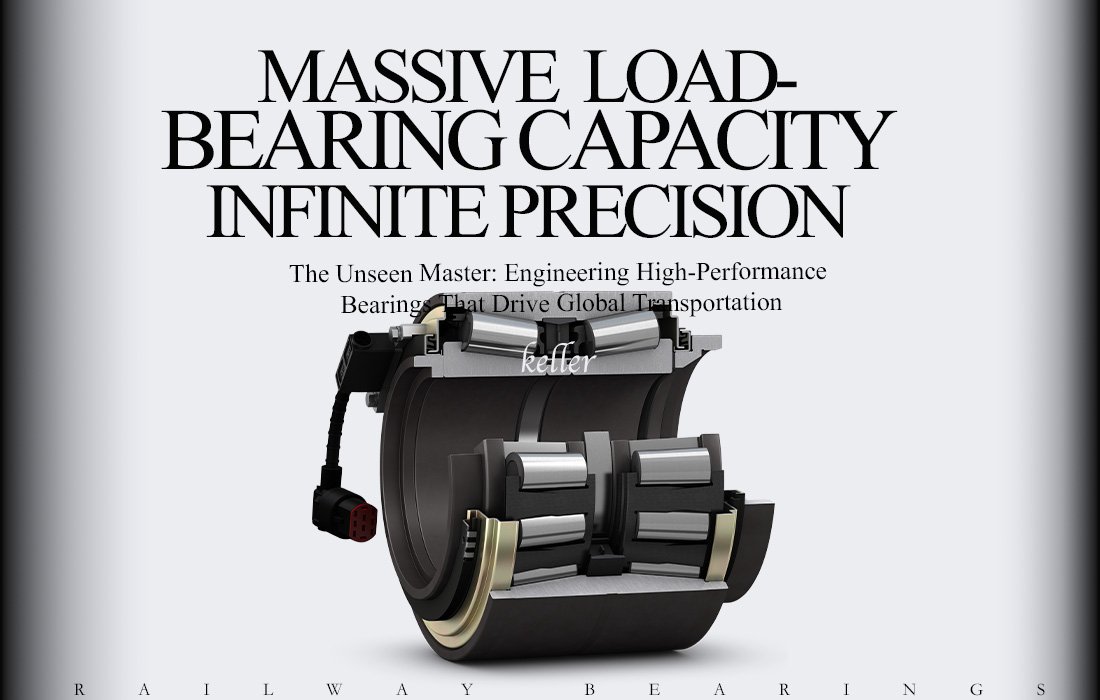
Railway bearing model numbers reflect information regarding the bearing’s structure and dimensions. Different models correspond to specific inner diameters, outer diameters, and widths. The appropriate model must be selected based on the axle box, axle, and operating conditions of the railway vehicle.
Railway bearing model numbers typically consist of a combination of numbers, letters, and suffixes. Designation rules vary according to different standards. Common identifiers indicate the bearing type, dimension series, and internal structure.
Correspondence Between Model Numbers and Dimensions
Railway bearing model numbers are closely linked to bearing dimensions. The inner diameter is usually indicated by the numerical portion of the model number, while the outer diameter and width are determined by the dimension series.
For instance, some cylindrical roller bearings use structural codes such as NU, NJ, and NUP. NU-type bearings primarily support radial loads. NJ-type bearings can support a certain amount of axial load. NUP-type bearings provide axial location (locating capability).
Tapered roller bearings typically use numerical model designations. These numbers correspond to the inner diameter, outer diameter, and width. Different dimension series are suited to specific axle and axle box configurations.
Correspondence Between Model Numbers and Structure
Letters within the model number usually denote the bearing structure. Different structures offer varying load-carrying capacities and installation characteristics.
NU-type cylindrical roller bearings offer good axial displacement capability, making them suitable for certain railway axle box applications.
NJ-type cylindrical roller bearings support radial loads and unidirectional axial loads, making them suitable for configurations requiring axial location.
NUP-type cylindrical roller bearings can support axial loads in both directions (within limits), making them suitable for fixed-end applications.
Tapered roller bearings can achieve enhanced axial locating capability through paired configurations; different configurations require matching installation dimensions.
Correspondence Between Model Numbers and Applications
Different railway vehicles require different bearing models. High-speed electric multiple units (EMUs) prioritize high-speed performance, temperature rise characteristics, and rotational precision. Locomotives and freight wagons prioritize load-carrying capacity and impact resistance.
Axle box bearings must match axle dimensions and axle box structures. Gearbox bearings must match gear shaft dimensions and operating speeds. Traction motor bearings require consideration of rotational speed, temperature, and insulation performance.
Method for Selecting Railway Bearing Models
When selecting a railway bearing model, first determine the installation location. Then, verify the shaft diameter, axle box dimensions, and available axial space. Next, select the bearing structure based on radial load, axial load, and rotational speed.
It is also necessary to confirm the bearing clearance, sealing method, and lubrication conditions. Different railway vehicle standards may utilize different models; therefore, the complete model designation and technical specifications should be verified during the actual selection process.
Model identification cannot rely on a single digit alone. Bearings with identical dimensions may feature different internal structures. Accurate model matching helps minimize installation issues and enhances operational stability.


