
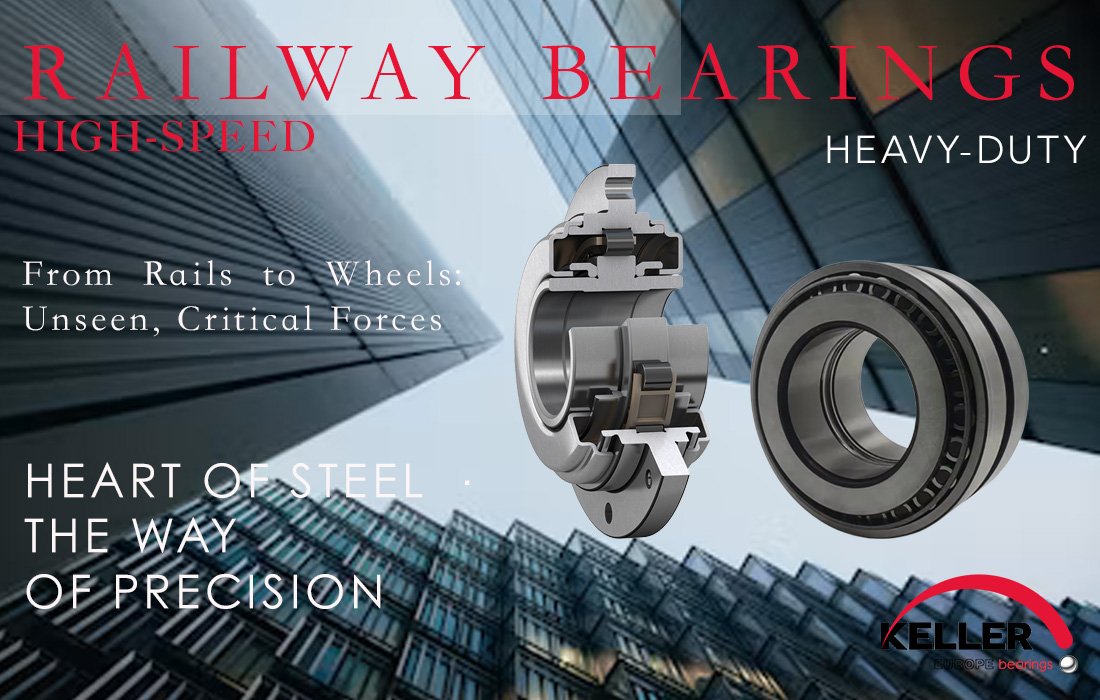
Gearbox bearings are critical components in the powertrains of Electric Multiple Units (EMUs). They primarily support the rotating shafts within the gearbox and must withstand both radial and axial loads generated during operation.
EMUs operate at high speeds, requiring gearbox bearings to accommodate high-speed rotation, continuous vibration, and temperature fluctuations. Stable bearing performance ensures the gearbox operates efficiently.
With the continuous development of high-speed rail, EMU gearbox bearings are evolving toward higher speeds, longer service lives, greater reliability, and reduced friction.
Functions of EMU Gearbox Bearings
The EMU gearbox is responsible for transmitting traction power. Gears and drive shafts rotate continuously at high speeds, and bearings provide stable support for these rotating components.
Bearings reduce friction during rotation and maintain the operational precision of the drive shafts.
When the train starts or accelerates, the gearbox is subjected to significant dynamic loads; bearings must maintain stable load-bearing capacity.
During high-speed operation, bearings must control friction and temperature rise. Optimal operating conditions help minimize energy loss.
Performance Requirements for EMU Gearbox Bearings
High-speed rail imposes rigorous demands on bearings.
High-speed performance is a key indicator. Given the high operating speeds of EMUs, bearings must maintain smooth rotation while controlling vibration and temperature rise.
High load-bearing capacity is equally important. Starting, accelerating, and braking generate complex loads, requiring bearings to adapt to various operating conditions.
A long service life reduces maintenance frequency. Factors such as bearing materials, heat treatment, and internal design influence longevity.
Sealing performance is also crucial. Gearboxes require effective lubrication; sealing structures minimize lubricant leakage and reduce the risk of external contaminants entering the bearing.
Common Types of EMU Gearbox Bearings
Appropriate bearing types are selected based on the specific structure of the EMU gearbox.
Cylindrical roller bearings offer excellent radial load-bearing capacity, making them suitable for drive systems subjected to heavy radial loads.
Tapered roller bearings can withstand both radial and axial loads, making them ideal for environments involving combined loads. Deep-groove ball bearings are characterized by their compact structure and smooth operation. Specific applications require selection based on the gearbox structure and operating parameters.
Impact of Lubrication on Gearbox Bearings
Lubrication directly affects the operating condition of gearbox bearings in electric multiple units (EMUs).
High-speed rotation generates frictional heat. Appropriate lubricating oil reduces friction and helps control bearing temperature.
Lubricating oil must maintain good viscosity stability and oxidation resistance. Suitable lubrication strategies must be selected based on varying rotational speeds and temperature conditions.
Additionally, the cleanliness of the lubricating oil must be controlled, as particulate impurities can increase bearing wear. Therefore, regular inspection of the lubrication status is essential.
Condition Monitoring of EMU Gearbox Bearings
Condition monitoring provides insight into bearing operation. Temperature, vibration, and noise are common monitoring parameters.
Vibration signals may change when abnormal bearing wear occurs. A continuous rise in temperature may also indicate anomalies in lubrication or operating conditions.
Data acquisition and analysis enable the early detection of abnormal trends. Intelligent monitoring systems also assist in formulating maintenance plans.
With the advancement of digital technology, bearing monitoring for EMUs is evolving toward real-time and intelligent systems.
Development Trends for EMU Gearbox Bearings
Future EMU gearbox bearings will increasingly focus on high-speed performance, extended service life, and lightweight design.
New bearing materials can enhance wear resistance. Advanced heat treatment technologies can improve material strength, while precision machining techniques enhance dimensional accuracy.
Intelligent sensing technology will also play a greater role, enabling real-time data collection on parameters such as bearing temperature, vibration, and rotational speed.
Data analysis allows for more accurate assessment of bearing conditions, and predictive maintenance can further reduce unplanned downtime.
Conclusion
Although compact in size, EMU gearbox bearings perform a critical support function and directly influence the operational stability of the gearbox.
High-speed rotation, complex loads, and long-term operating environments place demanding requirements on these bearings. Sound structural design, effective lubrication management, and condition monitoring can enhance bearing performance.
As high-speed rail technology continues to advance, EMU gearbox bearings will evolve toward greater speed, efficiency, reliability, and intelligence.


