
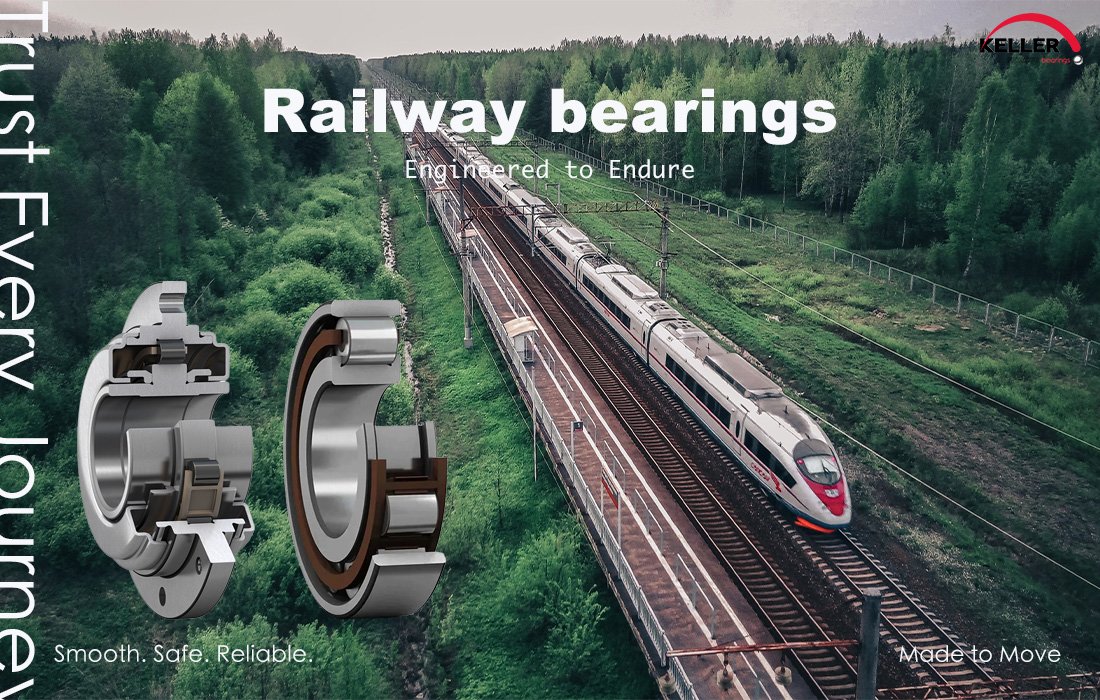
High-speed railway bearing units are critical components of high-speed train vehicles. They facilitate load transfer between the wheels and the bogie while supporting the stable rotation of the wheelset.
High-speed rail operations involve high speeds, placing stringent performance demands on bearing units. Bearings must withstand significant radial and axial loads and accommodate the temperature rise generated by high-speed rotation. Consequently, these units require excellent load-bearing capacity, sealing performance, and operational stability.
Primary Functions of High-Speed Railway Bearing Units
Bearing units connect the wheelset to the bogie and reduce friction during operation. They utilize a precision internal rolling structure, allowing the rolling elements to move smoothly.
During operation, wheelsets rotate continuously at high speeds, requiring the bearings to maintain stable performance. An optimized bearing structure minimizes frictional loss and reduces operational vibration and noise.
Bearing units also play a vital role in load transfer. Vehicle weight, operational impacts, and track irregularities generate varying loads; a sound structural design enables the bearings to handle these dynamic conditions effectively.
Structural Characteristics of High-Speed Railway Bearing Units
These units typically feature a precision bearing structure comprising an inner ring, an outer ring, rolling elements, a cage, and a sealing system.Rolling elements facilitate low-friction rotation, while the cage maintains their positioning. The sealing system prevents dust, moisture, and other contaminants from entering the bearing assembly.
Some units are integrated with the axle box structure. The overall design must meet specific installation dimensions while ensuring ease of maintenance and operational reliability.
Requirements Imposed by High-Speed Operation
High-speed operation increases the bearing’s workload; as rotational speed rises, controlling temperature increases becomes increasingly critical.Bearing units require effective lubrication to minimize friction and help regulate operating temperatures.
Material properties are equally important; high-quality materials ensure consistent strength and wear resistance, while precision manufacturing controls component dimensions and fit accuracy.
Sealing performance is also crucial. Given the railway operating environment—characterized by dust, moisture, and temperature fluctuations—an effective sealing structure minimizes the impact of external contaminants on the bearing’s internal components. Applications of High-Speed Train Bearing Units
High-speed train bearing units are primarily used in high-speed electric multiple units (EMUs) and high-speed railway rolling stock. Different vehicle models utilize varying bearing dimensions and structural designs.
Selection requires consideration of axle load, rotational speed, installation space, and operating environment. Temperature ranges and lubrication requirements must also be taken into account.For vehicles operating at high speeds over long periods, bearing stability is crucial. An appropriate bearing configuration helps ensure smooth vehicle operation.
How to Select High-Speed Train Bearing Units
When selecting high-speed train bearing units, the first step is to confirm dimensional parameters, such as inner diameter, outer diameter, and width.Next, load requirements must be verified. Axle loads vary across different vehicle types, so bearings must match actual operating conditions.
Rotational speed parameters are also critical; high-speed operation demands excellent high-speed performance from the bearings. Lubrication methods and sealing structures must be compatible with the operating environment.
Additionally, installation methods and maintenance requirements should be considered. Proper selection can reduce the burden of future maintenance.
Export Value of High-Speed Train Bearing Units
As high-speed railway networks expand, international demand for core high-speed train components is rising. High-speed train bearing units are specialized railway components.
International clients typically focus on product dimensions, structure, materials, and technical specifications. Clear product information enables clients to quickly determine whether a product meets their project requirements.
For international procurement projects, product documentation should include detailed specifications. Accurate English product names and technical descriptions facilitate client searches and product selection.
High-speed train bearing units impact both operational efficiency and long-term stability. Therefore, product selection requires a comprehensive assessment based on actual operating conditions.
Conclusion
High-speed train bearing units play a vital role in supporting wheelsets and transferring loads. High-speed operating environments impose rigorous demands regarding bearing precision, materials, lubrication, and sealing.
Proper selection of high-speed train bearing units ensures better alignment with the operational needs of high-speed railway vehicles. Clear technical specifications and accurate product information also help international clients improve procurement efficiency.


