
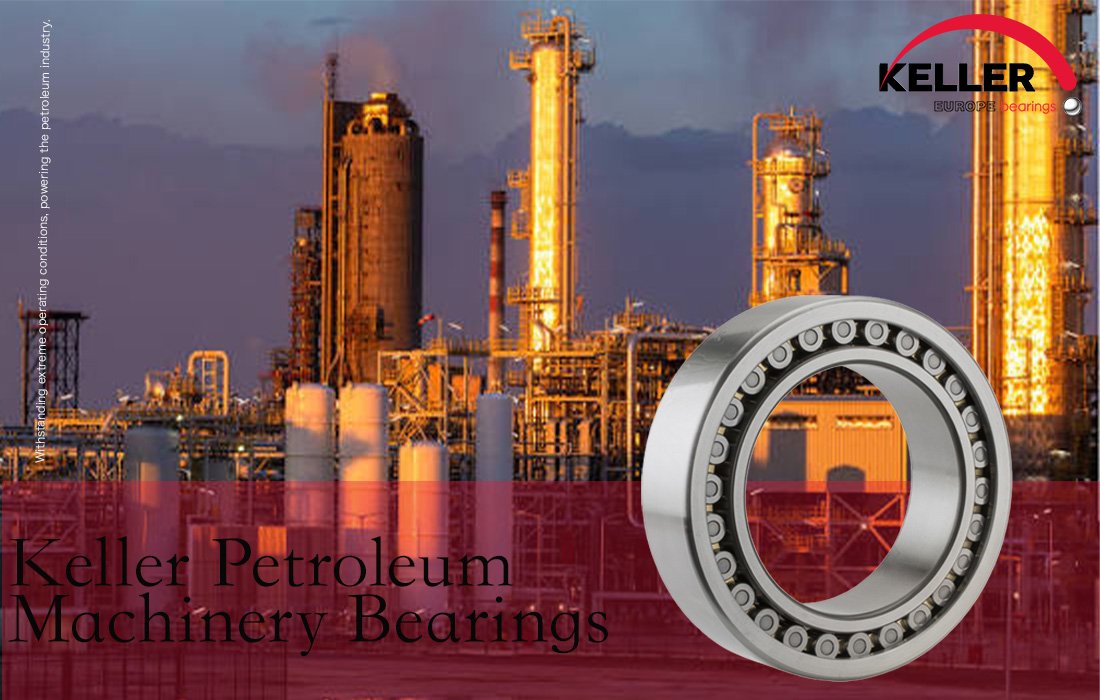
Bearings for petroleum equipment operate under conditions involving heavy loads, impacts, high temperatures, high speeds, and complex contamination; consequently, their performance requirements far exceed those of standard mechanical bearings. Bearing materials not only determine a product’s load-bearing capacity and wear resistance but also directly impact operational stability, service life, and maintenance costs. Therefore, selecting appropriate materials and enhancing their properties through sound manufacturing and heat treatment processes is fundamental to producing high-quality bearings for petroleum equipment.
I. Bearing Steel as a Common Base Material
Bearings for petroleum equipment generally require high strength, hardness, wear resistance, and fatigue life, making bearing steel a common base material. High-quality bearing steel, produced through strict compositional control and smelting processes, minimizes internal defects such as inclusions, providing the material foundation necessary for bearings to withstand high loads over the long term.
Different types of petroleum machinery require the selection of suitable material systems based on specific loads, rotational speeds, temperatures, and operating environments; a single material type cannot simply be applied to all operating conditions.
II. Alloy Materials Enhance Overall Performance
Under demanding conditions—such as heavy loads, impacts, and high temperatures—standard materials may fail to meet long-term usage requirements; thus, alloyed materials are often employed based on specific needs. The addition of appropriate alloying elements improves strength, hardenability, wear resistance, and high-temperature performance, enabling bearings to better adapt to the complex environments of oilfield operations.
Comprehensive mechanical properties are particularly critical for machinery subjected to significant impacts and loads, such as drilling equipment, mud pumps, and fracturing equipment.
III. Heat Treatment Determines Material Performance
The bearing material itself is merely the foundation; appropriate heat treatment processes are equally crucial. Processes such as quenching and tempering allow the bearing to achieve the optimal microstructure and hardness, thereby enhancing wear resistance and fatigue strength.
Improper control of heat treatment processes can result in insufficient hardness, excessive deformation, or abnormal internal microstructures, all of which compromise the bearing’s dimensional accuracy and service life. Consequently, a stable heat treatment process is a vital link in ensuring the quality of bearings for petroleum equipment.
IV. Balancing Hardness and Wear Resistance
During operation, the rolling elements and raceways of the bearing are subjected to continuous contact loads and friction. Appropriate hardness enhances surface wear resistance and minimizes dimensional changes caused by long-term operation.
However, higher hardness is not always better for bearings. Beyond surface hardness, material toughness and impact resistance must also be considered. For the complex operating conditions typical of petroleum machinery, achieving a proper balance among hardness, strength, and toughness is essential for stable and reliable performance.
V. Fatigue Life: A Critical Indicator
Bearings in petroleum equipment often operate continuously for extended periods, subjecting rolling elements and raceways to significant repetitive loads. Internal material defects, or suboptimal microstructure and heat treatment, can lead to fatigue cracks and, ultimately, failure modes such as spalling.
Therefore, high-quality bearing materials must possess excellent purity, microstructural uniformity, and fatigue resistance to minimize the risk of premature failure at the source.
VI. High-Temperature Performance: A Key Factor
Some petroleum machinery operates at elevated temperatures. When bearings run in such environments for long periods, material properties, dimensional stability, and lubrication conditions can all be compromised. Consequently, for high-temperature applications, it is necessary to select materials with superior heat resistance—tailored to specific temperatures and operating conditions—and to implement appropriate heat treatment and lubrication strategies.
VII. Strict Control from Raw Material to Finished Product
For bearing manufacturers with in-house production capabilities, product quality depends not only on material selection but also on the entire manufacturing process. Comprehensive quality control is typically implemented across stages such as raw material sourcing, forging, turning, heat treatment, grinding, assembly, and inspection.Strict quality checks begin upon the arrival of raw materials. Standardized forging processes refine the material’s microstructure, followed by precision turning and heat treatment. Subsequent grinding and assembly are succeeded by rigorous testing—covering dimensions, hardness, precision, and operational performance—to ensure the product meets actual application requirements.
In summary, material requirements for petroleum equipment bearings go beyond a simple pursuit of high hardness; they necessitate a holistic consideration of strength, hardness, wear resistance, fatigue resistance, toughness, and high-temperature performance. By selecting materials suited to specific operating conditions and employing proven manufacturing and heat treatment processes, manufacturers can produce reliable, durable bearings that ensure the long-term, stable operation of oilfield equipment.


