
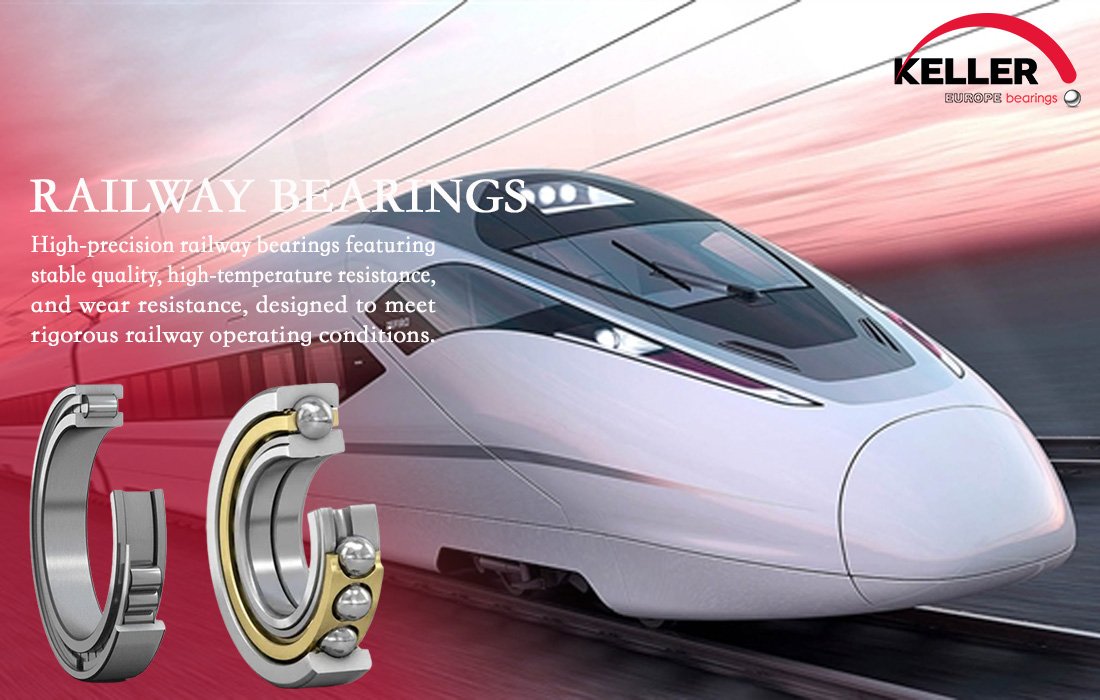
Railway bearings must withstand various types of loads. When selecting bearings, purchasers typically focus on dynamic load ratings and static load ratings. Understanding these two parameters helps customers choose the right bearings for their railway applications.
What is the dynamic load rating?
The dynamic load rating is usually denoted by the symbol C. It primarily reflects a bearing’s capacity to withstand dynamic loads.When railway vehicles are in motion, the bearings rotate continuously. Simultaneously, the axles are subjected to the vehicle’s weight, as well as shocks and vibrations. Consequently, the bearings must endure dynamic loads over long periods.Generally, a higher dynamic load rating indicates a greater load-carrying capacity. However, the C-value alone does not determine bearing service life; actual lifespan also depends on factors such as rotational speed, lubrication, load conditions, and the operating environment.
Railway vehicles often operate for extended periods. Therefore, purchasers must select an appropriate dynamic load rating based on actual operating conditions.
What is the static load rating?
The static load rating is usually denoted by the symbol C₀. It primarily reflects a bearing’s capacity to withstand static loads or loads applied at very low speeds.Bearings may be subjected to high static loads when railway vehicles are stationary, moving at low speeds, or experiencing significant impacts. Thus, the C₀ parameter is equally important.
If the actual load exceeds the bearing’s capacity, permanent deformation of the rolling elements and raceways may occur. Therefore, purchasers need to pay attention to the static load rating.For heavy-haul railway freight cars, static load requirements are often particularly critical. Additionally, complex track conditions can increase the impact loads experienced by the bearings.
Differences between dynamic and static load ratings
They serve different purposes. The dynamic load rating focuses on load-carrying capacity during rotational operation, whereas the static load rating focuses on capacity while the bearing is stationary or moving at low speeds.
Simply put, C relates to dynamic operational capacity, while C₀ relates to static load-bearing capacity.For example, high-speed trains operate at high speeds for long durations; therefore, purchasers should prioritize the dynamic load rating.On the other hand, heavy-haul freight cars must withstand substantial vehicle weight and impact forces; consequently, the static load rating cannot be overlooked.
How do you select railway bearings based on load?
First, the vehicle type must be identified. EMUs, locomotives, passenger coaches, and freight wagons operate under different conditions.Secondly, it is necessary to understand the actual loads, including both radial and axial loads.Next, operating speed must be considered; high-speed operation affects bearing temperature and fatigue life.Furthermore, lubrication, sealing, and operating temperatures also influence bearing performance. Therefore, purchasers should not select products based solely on C and C₀ values.
Professional railway bearing suppliers can offer selection recommendations based on the customer’s specific operating conditions. They can also provide data on dynamic load ratings, static load ratings, and other technical parameters.
Why are these two parameters important for international procurement?
Overseas buyers often need to compare product performance across different suppliers, and C and C₀ serve as key reference points.Standardized technical parameters facilitate product comparison for customers; thus, suppliers should provide comprehensive product data sheets.In addition, customers need to verify bearing dimensions, rotational speeds, materials, and lubrication methods. A comprehensive comparison is essential to selecting the right product.
Conclusion
Dynamic load rating (C) and static load rating (C₀) are critical parameters for railway bearings. C primarily reflects load-carrying capacity during dynamic operation, while C₀ primarily reflects capacity under static or low-speed conditions.
Consequently, selecting railway bearings requires considering both parameters alongside factors such as vehicle type, load, speed, and operating environment.
For overseas buyers, understanding the significance of C and C₀ improves the efficiency of the selection process and helps ensure the choice of reliable railway bearing products.


