
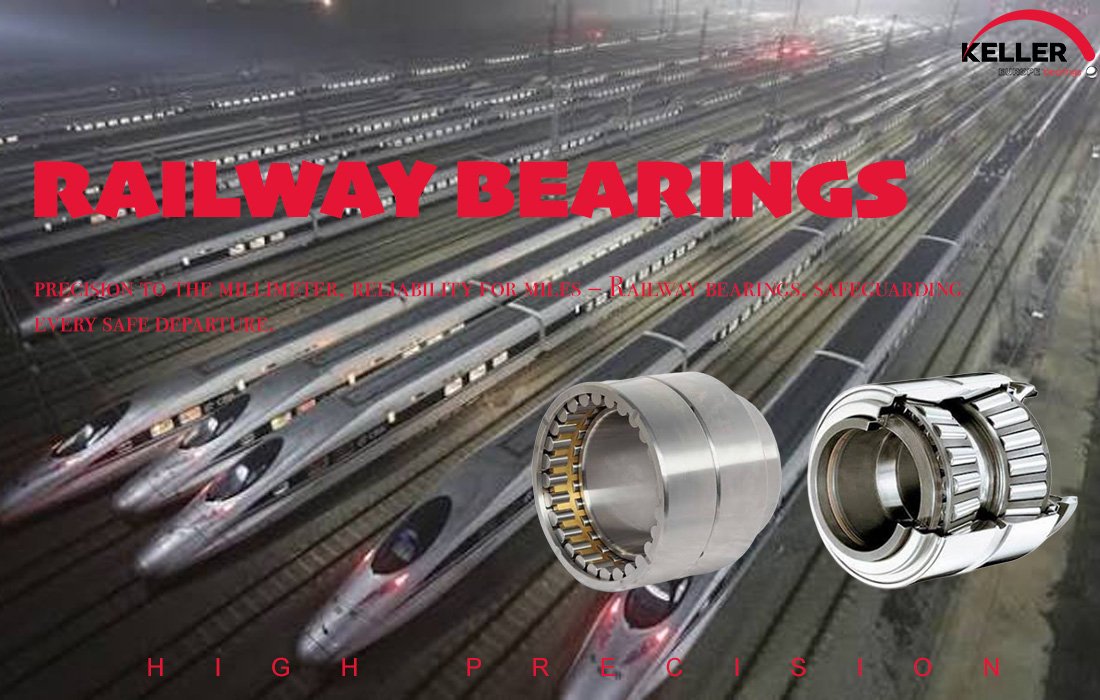
Railway vehicles operate for extended periods. Axles bear the loads generated by the car body, wheelsets, and operation. Axle bearings bear significant loads during axle rotation. They also affect wheelset operation, vehicle stability, and maintenance cycles. Therefore, axle bearings need to possess good load-bearing capacity, fatigue resistance, lubrication performance, and operational stability. Railway axle box rolling bearings also require attention to material, dimensional, quality control, and testing requirements. EN 12080:2025 sets forth relevant quality requirements for railway axle box rolling bearings.
1. High Load-Bearing Capacity
During railway vehicle operation, the weight of the car body is transferred to the wheelsets and axles. Axle bearings need to withstand significant radial loads. Simultaneously, vehicle operation also generates axial and dynamic loads.
Different vehicles have different axle loads. The operating conditions of passenger trains, high-speed trains, and freight trains also differ. Therefore, axle bearings need to be selected with appropriate structures based on the vehicle type.A reasonable bearing structure can improve load distribution. It can also reduce localized stress on the rolling contact surfaces.
2. Stable Operating Performance
Axle bearings need to maintain stable rotation over extended periods. High-speed operation increases friction and temperature rise. Vibrations during vehicle operation also affect bearing condition.High-precision machining improves bearing rotational accuracy. Appropriate internal clearance helps bearings adapt to temperature changes. Stable rotational performance reduces vibration and noise.
For high-speed railways, bearings also need to withstand higher operating speeds. For freight railways, bearings must primarily meet the requirements of high loads and long-term operation.
3. Good Fatigue Resistance
Railway vehicles perform numerous daily tasks. Axle bearings continuously bear repetitive loads. Long-term cyclic loading increases the fatigue risk of rolling contact surfaces.Therefore, bearings need good fatigue resistance. High-quality bearing steel increases material strength. Appropriate heat treatment processes also improve bearing performance.The internal quality of the material is equally important. EN 12080:2025 focuses on the material properties, geometry, quality assurance, and non-destructive testing of bearings.
4. Reliable Lubrication Performance
Lubrication directly affects the operating condition of axle bearings. Good lubrication reduces friction and wear. It also helps control bearing operating temperature.Railway vehicles operate for extended periods. Bearings need to maintain a stable lubrication condition. Grease also needs to adapt to different speed, load, and temperature conditions.A proper lubrication scheme can extend bearing life and reduce maintenance frequency. Railway axle box systems require comprehensive consideration of the matching between bearings, seals, and grease.
5. Good Sealing Performance
Railway vehicles may encounter rain, snow, dust, and humid environments. Moisture and contaminants can affect the lubrication condition inside the bearings.Therefore, axle bearings need reliable sealing performance. A good sealing structure reduces the entry of dust and moisture into the bearing.
The sealing structure also needs to reduce grease leakage. Stable sealing performance helps maintain a clean operating environment for the bearings and reduces maintenance requirements.
6. Strong Vibration Resistance
Railway vehicles generate vibrations and shocks during operation. When vehicles pass over curves, switches, and uneven tracks, the bearings are subjected to dynamic loads.Axle bearings need to maintain a stable internal structure. Rolling elements, races, and cages need to operate in coordination. A well-designed structure can reduce abnormal wear.For heavy-haul railway vehicles, bearings need to withstand greater dynamic loads. Therefore, material strength and structural stability are even more important.
7. Long Service Life
Railway vehicles need to maintain high operating efficiency. Frequent replacement of axle bearings increases maintenance time and operating costs.
Therefore, railway axle bearings need to have a long service life. High-quality materials, precision machining, proper lubrication, and reliable sealing can all extend bearing life.A longer service life reduces vehicle downtime. It also helps reduce maintenance costs in railway transportation.
8. Stringent Testing Requirements
Axle bearings require rigorous quality testing. Testing may include materials, dimensions, clearance, rotational performance, and internal quality.Railway axle box systems also require performance testing. EN 12082-1:2025 specifies the test methods for axle box rolling bearings, axle boxes, seals, and grease systems. These tests can evaluate the performance of the axle box system under different operating conditions.
Railway vehicles can also monitor the operating status of axle boxes through temperature monitoring. An abnormally high bearing temperature may indicate operational risks. Relevant railway standards also emphasize axle box temperature monitoring and condition control.
With the continuous development of railway transportation, axle bearings need to evolve towards higher speeds, longer lifespans, lower friction, and higher reliability. Reliable axle bearings can help railway vehicles maintain stable operation and improve transportation efficiency.


