
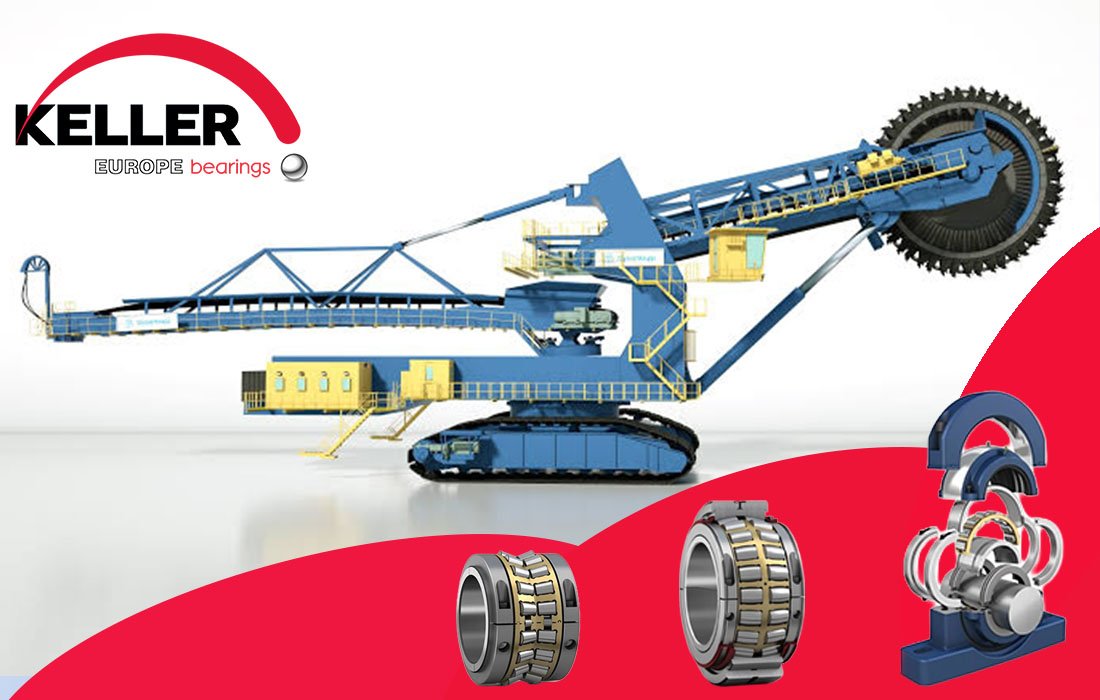
As core heavy-duty equipment for bulk material handling in ports, mines, and power plants, bucket wheel stacker reclaimers operate continuously under harsh, open-air conditions with heavy dust and intense workloads. Within their massive mechanical transmission and slewing systems, split bearings play a crucial role in ensuring high operational efficiency and enabling rapid maintenance through their unique structural advantages.
I. Operational Characteristics and Bearing Maintenance Pain Points of Bucket Wheel Machines
Combining excavation, slewing, stacking, and reclaiming functions, bucket wheel machines feature massive physical dimensions, extremely long drive and slewing shafts, and heavy loads. During operation, their bearings face severe challenges:
-
Extreme Spatial Constraints (The “Trapped Shaft” Phenomenon) .The bucket wheel shaft, slewing drive shafts, and long-distance conveyor roller shafts typically weave through massive booms, gearboxes, couplings, and drive motors. Traditional solid bearings require sufficient axial clearance and movement at the shaft ends for installation and removal. However, in the complex transmission chains of a bucket wheel machine, shafts are tightly “trapped” on both ends by other heavy components, meaning replacing a standard bearing would require completely dismantling the entire transmission system.
-
Heavy Hoisting and Dismantling Costs .When a conventional bearing wears out or fails, it often requires mobilizing large cranes and spending days hoisting tons of heavy reducers, motors, or the entire bucket wheel shaft away from the site. This leads to prolonged unplanned downtime for ports or power plants, resulting in massive economic losses.
-
During operation, bucket wheel machines generate huge amounts of coal or ore dust and endure intense excavation impact loads, imposing exceptionally high demands on bearing sealing performance and load capacity.
II. Specific Application Areas of Split Bearings in Bucket Wheel Machines
To address these pain points, split bearings are precisely applied to the most difficult-to-maintain and critical transmission and slewing nodes of a bucket wheel machine:
-
Bucket Wheel Drive and Reduction Transmission Shafting .The main bucket wheel shaft and its rear-connected reduction transmission shaft are the core load-bearing points for bulk material excavation. Applying split cylindrical roller bearings or split spherical roller bearings here perfectly accommodates high torque and alternating impact loads.
-
Boom Conveyor and Tail Conveyor Roller Shafts. Bucket wheel machines are packed with long-distance belt conveyors used to transport excavated materials to the storage yard. The bearing positions of drive pulleys and redirect pulleys are often situated deep inside the cramped machine frame, where split bearings allow for direct, in-situ replacement.
-
Slewing Support and Auxiliary Transmission Mechanisms. In the slewing and luffing mechanisms of bucket wheel machines, some multi-support drive shafts also widely utilize split bearings to optimize structure and simplify assembly due to spatial limitations.
III. Core Value Brought by Split Bearings to Bucket Wheel Machines
-
Revolutionary “In-Situ Maintenance” Capability .This is the core value of split bearings in bucket wheel machines. Because their inner rings, outer rings, cages, and bearing housings can all be split axially into two halves, maintenance personnel do not need to dismantle surrounding couplings, gearboxes, or motors when replacing a bearing. They simply remove the old bearing and “wrap” the two halves of the new bearing directly onto the shaft, securing them with bolts.
-
While replacing a traditional bearing might take 3 to 5 days of heavy dismantling work, using a split bearing cuts emergency repair time down to just a few hours. For time-sensitive ports and thermal power plants, this drastically increases equipment availability.
-
Significantly Lowering Comprehensive Maintenance Costs and Safety Risks .By eliminating the need to rent large cranes, flip and hoist heavy components, and perform tedious high-altitude or confined-space heavy labor, split bearings substantially cut labor and maintenance costs while effectively reducing on-site safety risks.
-
Reliable Sealing and Dust-Proof Design .Modern split bearings applied to bucket wheel machines are typically equipped with high-performance split labyrinth seals or contact seals, effectively blocking out mineral dust, coal fines, and rain to ensure long-term, stable operation in heavily polluted environments.
Recommended common bearing models for bucket-wheel machines:
01EB120MEX/01EB120MGR
01EB180MEX/01EB180MGR
01EB200MEX/01EB200MGR
01EB240MEX/01EB240MGR
01EB260MEX/01EB260MGR
01EB280MEX/01EB280MGR
01EB320MEX/01EB320MGR
02EB220MEX/02EB220MGR
02EB240MEX/02EB240MGR
02EB260MEX/02EB260MGR
02EB280MEX/02EB280MGR
02EB320MEX/02EB320MGR
Conclusion
In heavy bulk material machinery like bucket wheel stacker reclaimers—where physical scale is massive and maintenance is exceptionally difficult—split bearings break the traditional curse of “pulling one hair and moving the whole body” in bearing maintenance. With a “simplify-the-complex” installation logic and superior load-bearing performance, they serve as a solid safeguard for the continuous, safe, and efficient operation of bucket wheel machines.


