
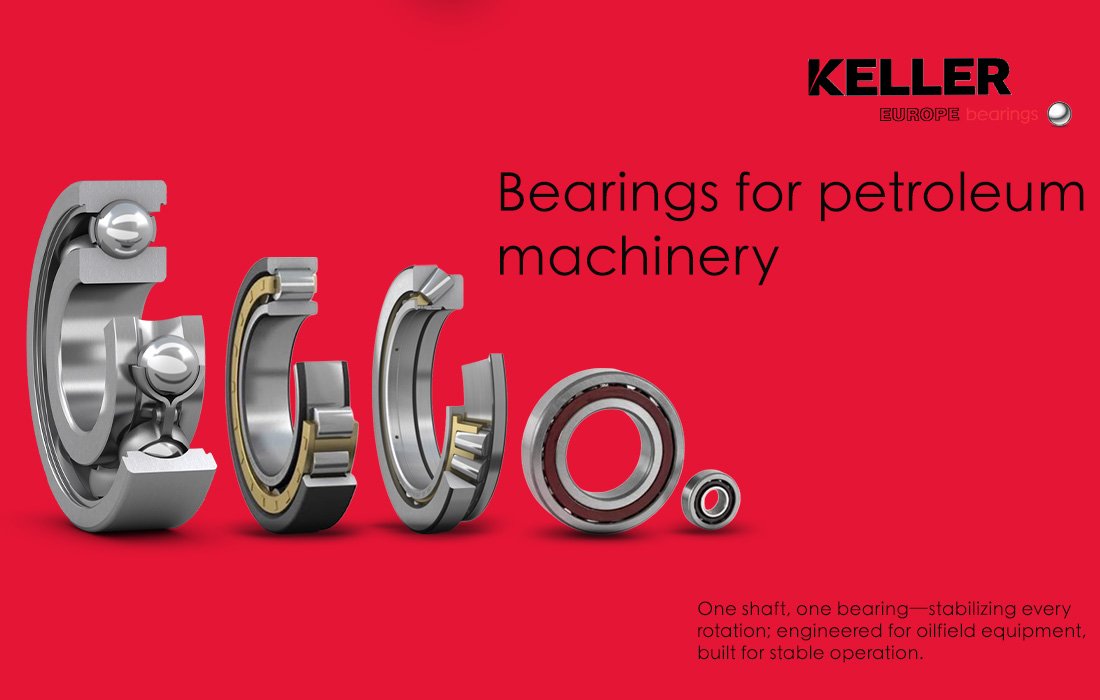
Bearings in petroleum machinery often operate in demanding environments characterized by heavy loads, shock, high temperatures, high speeds, dust, and mud. Proper lubrication is crucial for ensuring stable bearing operation, minimizing wear, and extending service life. Since different equipment and operating conditions impose varying requirements, the selection of a lubrication scheme must take into account factors such as bearing rotational speed, load, temperature, operating environment, and maintenance conditions.
I. Grease Lubrication
Grease is a common lubrication method for petroleum machinery bearings. It offers advantages such as ease of use, good adhesion, and strong sealing properties, making it suitable for equipment operating at low to medium speeds and moderate loads, as well as for machinery requiring long maintenance intervals.For certain oilfield machinery, proper grease application combined with effective sealing can prevent contaminants—such as dust, moisture, or other foreign matter—from entering the bearing. However, more grease is not necessarily better; the fill quantity must be controlled according to the bearing structure and equipment specifications.
II. Lubricating Oil Lubrication
Lubricating oil offers superior fluidity and heat dissipation capabilities, making it ideal for high-speed bearings and applications requiring strict control over temperature rise. Compared to grease, lubricating oil more effectively carries away heat generated during operation, leading to its widespread use in high-speed, high-temperature, or continuously operating equipment.When selecting lubricating oil, factors such as rotational speed, operating temperature, load, and bearing type must be considered to ensure the oil possesses the appropriate viscosity and stability.
III. Oil Bath Lubrication
In oil bath lubrication, the bearing is partially submerged in oil, and the rotation of the bearing carries the oil into the working zone. This method features a relatively simple design and is suitable for equipment operating at low to medium speeds with stable running conditions.It is important to note that a higher oil level is not always better. An excessively high oil level creates significant churning resistance as the bearing rotates, leading to temperature increases and energy loss; therefore, the oil level should be maintained according to the equipment’s design specifications.
IV. Circulating Oil Lubrication
Circulating oil lubrication offers distinct advantages for petroleum machinery operating at high speeds, under heavy loads, or continuously. Lubricating oil continuously enters the bearing’s operating zone, carrying away generated heat, while its condition is maintained through processes such as filtration and cooling.
This method is suitable for equipment requiring strict temperature control and operational stability; however, it entails a more complex system structure and higher maintenance demands, requiring regular inspections of oil lines, oil levels, filtration systems, and the condition of the lubricant itself.
V. Lubrication under High-Temperature Conditions
Some petroleum machinery operates at elevated temperatures, which accelerate lubricant aging and degrade lubricating performance. Therefore, under high-temperature conditions, lubricants with excellent thermal stability and oxidation resistance should be selected, and the intervals for replenishment and replacement should be adjusted appropriately based on actual operating temperatures.At the same time, attention must be paid to the bearing’s material, sealing structure, and heat dissipation conditions; one cannot rely solely on the lubricant to resolve high-temperature issues.
VI. Lubrication under High-Speed Conditions
During high-speed operation, internal friction and heat generation within the bearing become more pronounced. Key factors to consider include lubricant viscosity, the oil supply method, and heat dissipation capabilities. Oil lubrication or circulating oil systems are often more effective at ensuring a stable oil supply and adequate heat dissipation in high-speed equipment.
However, the specific lubrication strategy should be determined based on the bearing model, rotational speed, and equipment structure to prevent excessive temperature rise caused by an unsuitable lubricant choice.
VII. What Are the Effects of Insufficient or Excessive Lubrication?
Insufficient lubrication increases friction between the bearing’s rolling elements and raceways, leading to higher temperatures and accelerated wear; it may also result in noise, vibration, or even bearing seizure (burning).Excessive lubrication can also cause problems. An overabundance of grease increases rotational resistance, raising the temperature, while an excessive oil level can lead to significant churning losses. Therefore, more lubrication is not necessarily better; maintaining an optimal amount of lubricant is essential.
VIII. How to Select the Right Lubrication Strategy?
The lubrication strategy for petroleum machinery bearings should be determined by comprehensively considering load, rotational speed, operating temperature, environmental contamination levels, equipment structure, and maintenance conditions. Generally, grease lubrication is preferred for low- to medium-speed equipment; oil lubrication is suitable for high-speed equipment or applications requiring effective heat dissipation; and circulating oil lubrication may be adopted for equipment operating continuously under high speeds and heavy loads, depending on actual conditions. A sound lubrication strategy reduces bearing friction and wear while enhancing equipment operational stability. Selecting high-quality bearings suited to actual operating conditions—combined with appropriate lubrication methods, optimal lubrication intervals, and standardized maintenance management—can effectively extend bearing service life, minimize the risks of equipment downtime and repairs, and ensure the long-term, stable operation of petroleum machinery.


