
Stainless steel is a key material in cold rolling production, characterized by high strength and work-hardening properties. As the rolling process progresses, the material’s resistance to deformation increases; consequently, cold rolling stainless steel requires substantial rolling force. At the same time, the product demands high precision regarding thickness and flatness, as well as superior surface quality.
The 20-high rolling mill is ideally suited for these operating conditions. It employs a multi-roll support structure in which small-diameter work rolls perform the actual rolling, while intermediate rolls and backing rolls provide collective support. This configuration enhances mill rigidity and helps control roll deformation.
Why does stainless steel cold rolling require a 20-high structure?
Stainless steel generally possesses higher strength than ordinary low-carbon steel. Significant work hardening occurs during rolling, and rolling forces fluctuate as the reduction amount increases.
Conventional rolling mills utilize large-diameter work rolls. While large-diameter rolls offer high rigidity, they limit the ability to roll thin-gauge materials. In contrast, 20-high mills use small-diameter work rolls, which reduce rolling deformation and improve the capability to roll thin strip materials.
Multiple support rolls distribute the rolling load and help control the deflection of the work rolls, enabling the mill to operate stably even under high rolling forces.
How do 20-high rolling mills improve rolling precision for stainless steel?
Stainless steel products require high thickness precision; even slight variations in thickness—particularly in thin-gauge strip—can impact subsequent processing steps.
The 20-high cold rolling mill enhances the rigidity of the roll assembly through its multi-roll structure, establishing stable support relationships between the rolls and allowing rolling forces to be transmitted through the roll assembly to the mill housing.
This structure facilitates the control of roll deflection and helps maintain a stable roll gap, which is crucial for controlling the thickness of the steel strip.
Modern 20-high rolling mills also integrate technologies such as hydraulic screw-down, roll bending, and flatness control, allowing these control methods to be adjusted to meet specific production requirements.
Why is the 20-high rolling mill suitable for producing thin stainless steel strip?
Cold-rolled stainless steel products span a wide range of thicknesses, with some requiring very thin gauges. The thinner the material, the higher the precision requirements for the rolling equipment.
The 20-high rolling mill utilizes small-diameter work rolls, which can exert high specific rolling pressure, while multiple backing rolls provide stable support.
This configuration enables significant thickness reduction while maintaining excellent strip shape control. Consequently, 20-high mills are frequently used for the production of thin and precision stainless steel strip.
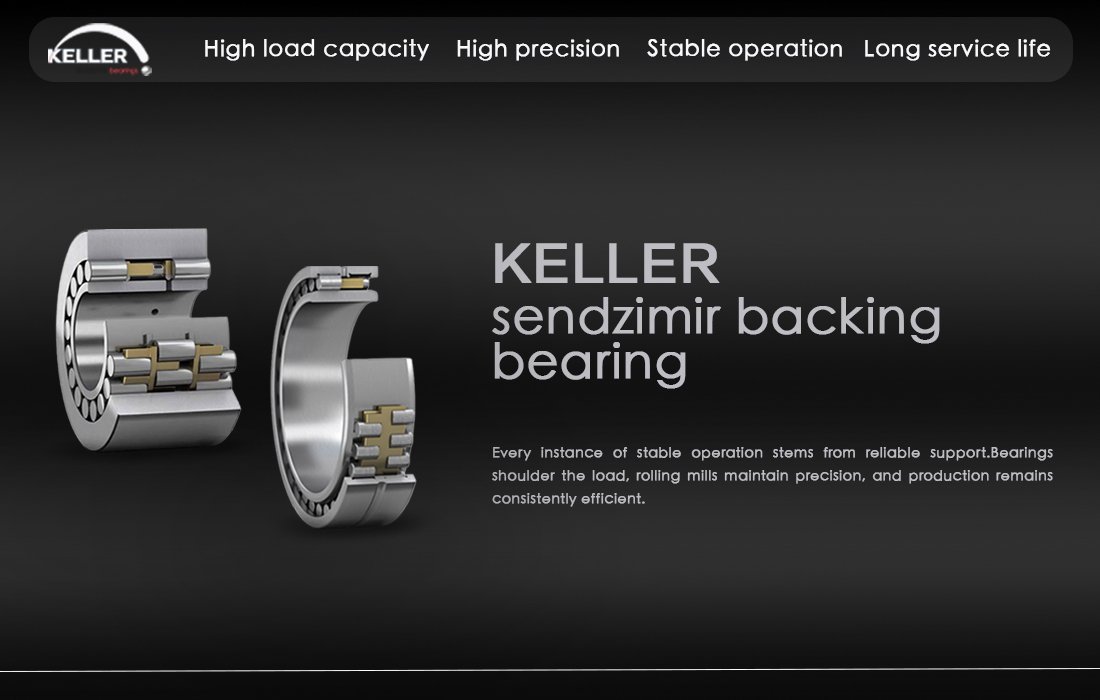
Why are backing bearings important?
In a Sendzimir 20-high rolling mill, backing bearings play a crucial support role, directly participating in the transmission of loads within the roll assembly.
Rolling stainless steel involves high forces, requiring the backing bearings to withstand continuous loads. Higher rolling speeds place even greater demands on bearing performance.
Factors such as dimensional accuracy, rotational precision, and internal clearance affect the operation of the roll assembly, as does the lubrication condition; contaminants, insufficient lubrication, and abnormal temperature rises can all impact bearing performance.
Thus, backing bearings—along with the rolls, mill housing, and shape control system—collectively influence rolling stability.
Can a 20-high rolling mill improve stainless steel surface quality?
Stainless steel products often demand high surface quality. The cold rolling process requires stable operating conditions; factors such as roll surface quality, rolling oil, rolling pressure, and equipment precision all influence the final surface finish.
The 20-high rolling mill maintains a stable rolling process through precise control of the roll gap and rolling force. This stability helps minimize thickness fluctuations and strip shape issues.This is particularly important for stainless steel strip requiring superior surface quality.
Which stainless steel products are suitable for 20-high cold rolling?
20-high cold rolling mills can process a wide variety of stainless steel strips. Common materials include austenitic stainless steel, ferritic stainless steel, and other alloy steel grades. These materials find further application in automobiles, home appliances, kitchenware, elevators, architectural decoration, industrial equipment, and precision manufacturing.
Different materials possess varying levels of strength, hardness, and workability. Consequently, actual production requires adjustments to the rolling process based on material grade, entry thickness, target thickness, and specific product requirements.
What are the core advantages of the 20-high rolling mill?
The primary reason for choosing a 20-high mill for stainless steel cold rolling is its ability to simultaneously deliver high rolling force, the capability to roll thin gauges, and high-precision control.
Small-diameter work rolls enhance the capacity for rolling thin strips, while a multi-stage support system increases the rigidity of the roll assembly. Additionally, precision control systems help maintain consistent thickness and strip shape.
Therefore, the Sendzimir 20-high mill holds significant value in the field of precision cold rolling for stainless steel.
Conclusion
Stainless steel cold rolling demands both stable rolling force and high dimensional accuracy. The 20-high mill meets these production requirements through its use of small work rolls and a multi-roll support structure.
From thin-strip rolling and shape control to surface quality, the 20-high configuration offers distinct technical advantages. As a result, the Sendzimir 20-high mill has become a vital piece of equipment in stainless steel cold rolling production.
Within the rolling system, the work rolls, intermediate rolls, backing rolls, and backing bearings work in concert to perform the rolling task; every component influences the final rolling outcome.


