
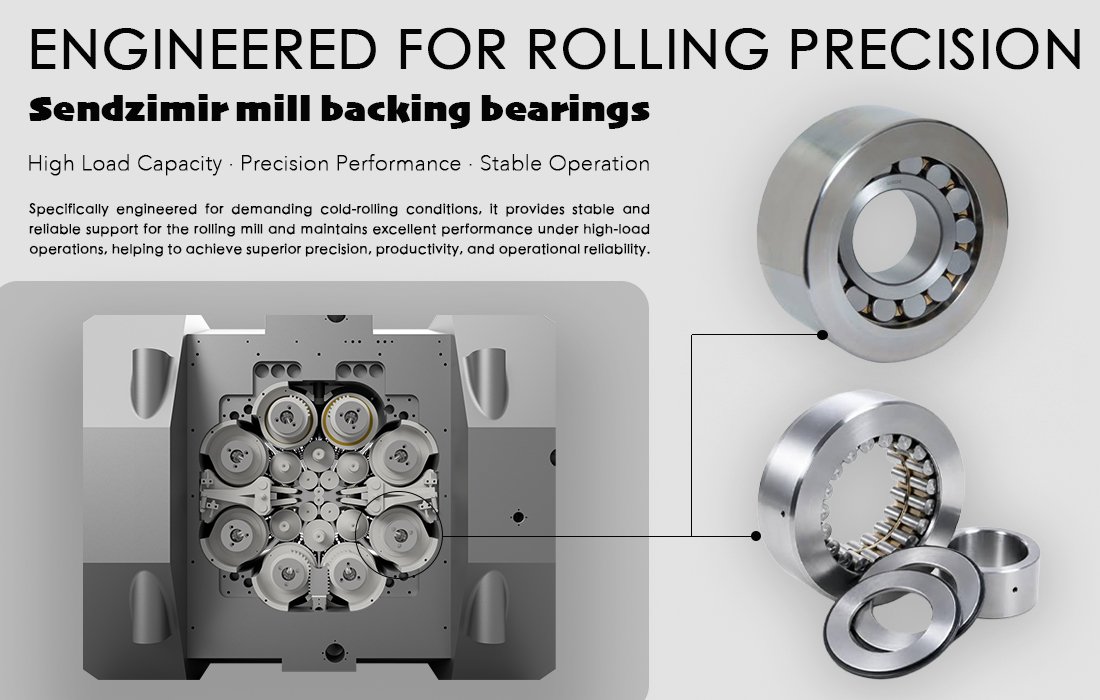
The Sendzimir 20-roll mill is a classic type of multi-roll cold rolling mill. It employs a distinctive 1-2-3-4 roll configuration, with the entire roll assembly arranged around the upper and lower work rolls. Each type of roll performs specific support and force-transmission functions.
Structurally, the Sendzimir 20-roll mill comprises two work rolls, four first intermediate rolls, six second intermediate rolls, and the outermost backing bearing assemblies. While terminology may vary depending on the specific design, the fundamental principle is to create a stable roll assembly through multi-stage support. Rolling forces are transmitted outward from the work rolls, stage by stage, until they reach the mill housing.
The two work rolls perform the actual rolling
The work rolls are the rolls that come into direct contact with the metal strip in a Sendzimir 20-roll mill. There is one work roll at the top and one at the bottom, with the metal strip passing between them. These rolls exert direct pressure on the strip to reduce its thickness.
A key characteristic of the Sendzimir mill is the relatively small diameter of its work rolls. Small-diameter work rolls enhance the mill’s capability to roll thin-gauge strip and minimize roll deflection.The surface condition of the work rolls directly affects the surface quality of the strip; therefore, the material, surface finish, and dimensional accuracy of the work rolls are critical.
The four first intermediate rolls support the work rolls
The first intermediate rolls are positioned immediately outside the work rolls. With two located at the top and two at the bottom, there are four first intermediate rolls in total.These rolls do not make direct contact with the strip. Instead, they primarily support the work rolls and transmit the rolling forces they receive further outward.
The first intermediate rolls also play a role in controlling strip shape (flatness). Some Sendzimir mills utilize control methods such as the lateral shifting of intermediate rolls; adjusting their position alters the roll gap profile, thereby helping to improve the strip’s shape.
The six second intermediate rolls transmit rolling forces further outward
The second intermediate rolls are located outside the first intermediate rolls. There are three rollers on each of the top and bottom sides, making a total of six second intermediate rolls in the system.The second intermediate rolls provide further support for the first intermediate rolls, transferring the load outward. Some of the second intermediate rolls also serve a drive function.
In a typical 20-roll configuration, there are three second intermediate rolls on both the top and bottom sides. The specific drive arrangement varies depending on the mill design and process requirements.Backup bearings provide the outermost support.The outermost layer of a Sendzimir 20-roll mill utilizes a backup bearing support system. These backup bearings do not come into direct contact with the steel strip; instead, they primarily support the second intermediate rolls and withstand the substantial loads generated during the rolling process.
The backup bearings transfer the load from the roll assembly to the mill housing, creating a stable structural arrangement for the entire roll system.This is why Sendzimir backup bearings require high dimensional precision and operational stability; the performance of the bearings affects the support of the roll assembly, which in turn impacts rolling precision.
How do the components of a 20-roll mill work together?
A Sendzimir 20-roll mill can be understood as a progressive support system.The strip first enters between the top and bottom work rolls. The work rolls apply rolling pressure directly to the strip, transferring the resulting force outward to the first intermediate rolls.
The first intermediate rolls then transfer the load to the second intermediate rolls, which in turn pass it on to the outer backup bearing support system.Finally, the backup bearing system transfers the load to the mill housing.
The entire process can be summarized as follows:
Strip → Work rolls → First intermediate rolls → Second intermediate rolls → Backup bearings → Mill housingThis multi-stage support structure minimizes deflection in the work rolls. It also enhances the overall rigidity of the mill and helps maintain a stable roll gap.
Why does a Sendzimir mill require such a complex roll assembly?
Standard rolling mills do not require such complex roll assemblies. Sendzimir mills are designed primarily for high-strength materials and thin-gauge strip.Materials such as stainless steel possess high resistance to deformation. Significant rolling forces are generated during the rolling process. Relying solely on large-diameter work rolls makes it difficult for equipment to simultaneously handle thin-gauge rolling and ensure effective strip shape control.
Sendzimir mills utilize small-diameter work rolls. Multiple intermediate rolls and backing bearings work together to provide support, ensuring the work rolls maintain excellent stability.Consequently, the 20-roll configuration enables the processing of harder materials under high rolling pressures while facilitating precise control over strip thickness and shape.
What advantages does the 20-roll configuration offer for stainless steel cold rolling?
Stainless steel is a primary material processed by Sendzimir 20-roll mills.Cold rolling stainless steel requires substantial rolling force. Furthermore, thin-gauge products demand high precision in both thickness and strip shape.
The 20-roll configuration minimizes work roll deformation. A stable roll cluster helps maintain a consistent roll gap. When combined with modern rolling control technologies, the equipment meets the production requirements for a wide range of stainless steel products.
As a result, Sendzimir 20-roll mills are widely used for the cold rolling of thin-gauge stainless steel strip. They are also employed for silicon steel, precision alloys, and other high-strength metal strips.
Conclusion
The Sendzimir 20-roll mill represents more than just an increase in the number of rolls; the 20 rolls and the backing bearing support system combine to form an integrated multi-roll support structure.
Two work rolls perform the actual rolling. Four first-intermediate rolls support the work rolls, while six second-intermediate rolls further transmit the load. Backing bearings provide the outermost layer of support.
This 1-2-3-4 roll cluster structure grants the Sendzimir mill high rigidity and precision rolling capabilities—key reasons why the 20-roll mill is ideally suited for the cold rolling of stainless steel and other high-strength metals.


