
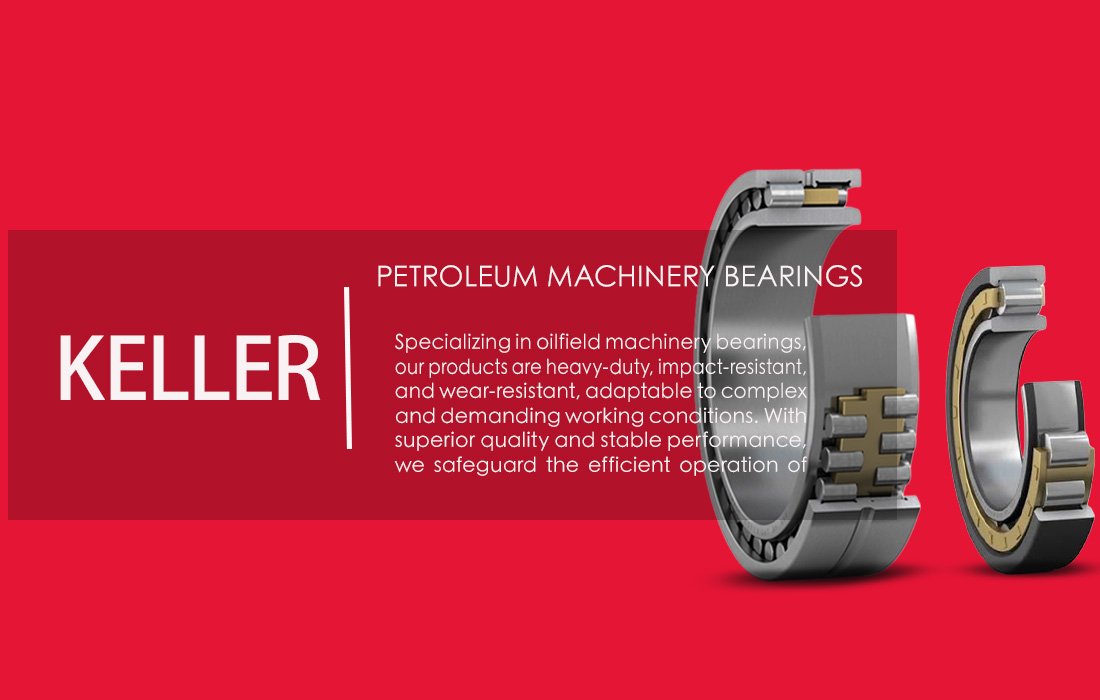
In oil drilling, production, transportation, and the operation of oilfield equipment, bearings, although fundamental components, directly affect the equipment’s rotational efficiency, operational stability, and service life. Compared to ordinary industrial equipment, oilfield machinery typically faces heavy loads, impacts, vibrations, continuous operation, and complex environments. Therefore, oilfield equipment bearings require higher material performance. So, why do oilfield equipment bearings have higher material requirements?
I. Oilfield Equipment Bearings Face More Complex Operating Conditions
During actual operation, oilfield drilling and production equipment bearings need to withstand significant radial and axial loads, and some equipment also experiences substantial impact loads and vibrations. For example, bearings in oil drilling rigs, mud pumps, and pumping units need to continuously bear mechanical loads during long-term operation.
If the strength, toughness, or wear resistance of the bearing material is insufficient, fatigue, wear, and deformation are likely to occur during long-term use, thus affecting the normal operation of the equipment. Therefore, oilfield machinery bearing materials must first possess excellent comprehensive mechanical properties.
II. They Need Higher Load-Bearing Capacity
Oilfield equipment is typically heavy machinery, requiring bearings with high load-bearing capacity. Significant contact stresses occur between the rolling elements and raceways of bearings. If the material’s hardness and contact fatigue performance are insufficient, pitting and spalling may occur after prolonged operation.
Therefore, bearings for petroleum equipment typically require materials with good strength, hardness, and contact fatigue performance, and their properties are improved through appropriate heat treatment processes to ensure stable operation under high loads.
III. Good Wear Resistance is Crucial
Many petroleum machinery pieces require continuous operation for extended periods, resulting in constant friction in the bearings. Insufficient wear resistance in the material can lead to wear on the bearing’s working surface, causing changes in bearing clearance, increased vibration, and even malfunctions.
High-quality bearing materials, combined with appropriate manufacturing and heat treatment processes, can improve the wear resistance of the working surface, reduce the wear rate during long-term operation, and thus help extend the service life of petroleum machinery bearings.
IV. Good Impact and Fatigue Resistance is Required
The working environment of petroleum drilling and production equipment is not always stable. Bearings may be subjected to sudden impacts during start-up, stopping, reversing, and load changes.
If the material’s toughness is insufficient, the bearing may crack or suffer other damage when subjected to significant impacts. Therefore, bearings for petroleum equipment not only require hardness but also reasonable toughness and fatigue resistance to maintain structural stability under high loads and impact conditions.
V. Complex Environments Present Challenges to Bearing Materials
Petroleum equipment operates in complex environments, with some equipment potentially exposed to dust, mud, oil, and humidity for extended periods. Insufficient protection or sealing measures allow external contaminants to enter the bearing, accelerating wear on raceways and rolling elements.
Therefore, when selecting bearing materials for petroleum equipment, it is necessary to consider the material’s corrosion resistance and overall protection scheme in conjunction with the specific operating environment. Bearing materials, lubrication methods, and sealing structures need to be coordinated to better adapt to actual operating conditions.
VI. Materials and Heat Treatment Processes Are Equally Important
Bearing performance does not entirely depend on raw materials. Even with high-quality bearing steel, inadequate heat treatment processes, machining precision, or manufacturing process control can affect the final product’s performance.
For petroleum machinery bearings, it is necessary to rationally control material properties based on the product structure and operating conditions, and improve hardness, wear resistance, and contact fatigue performance through appropriate heat treatment processes. Simultaneously, strict quality control of the bearing manufacturing process is also required.
VII. How to Select Bearing Materials for Petroleum Equipment?
In actual procurement and selection, bearing quality cannot be judged solely by the material name. More importantly, a comprehensive assessment must be made considering the equipment’s load, speed, temperature, impact intensity, lubrication conditions, and operating environment.
Different petroleum equipment operates under different conditions, and the tasks undertaken by drilling rig bearings, pumping unit bearings, mud pump bearings, and oil pump bearings also differ. Therefore, bearing materials and manufacturing processes should be matched according to specific applications.
Conclusion
Overall, petroleum equipment bearings have higher material requirements, primarily due to their more complex operating environment, greater load-bearing capacity, longer operating time, and potential exposure to various factors such as impact, vibration, and contamination.
High-quality bearing materials provide a fundamental guarantee for the bearing’s load-bearing capacity, wear resistance, fatigue resistance, and operational stability. For petroleum machinery equipment manufacturers and purchasing companies, when selecting petroleum machinery bearings, they should comprehensively consider materials, heat treatment, processing technology, quality inspection, and actual application conditions to select bearing products that match the equipment’s requirements.
Keywords: oil equipment bearings, oil machinery bearings, oil drilling rig bearings, oil machinery bearing materials, oil drilling and production equipment bearings.


