
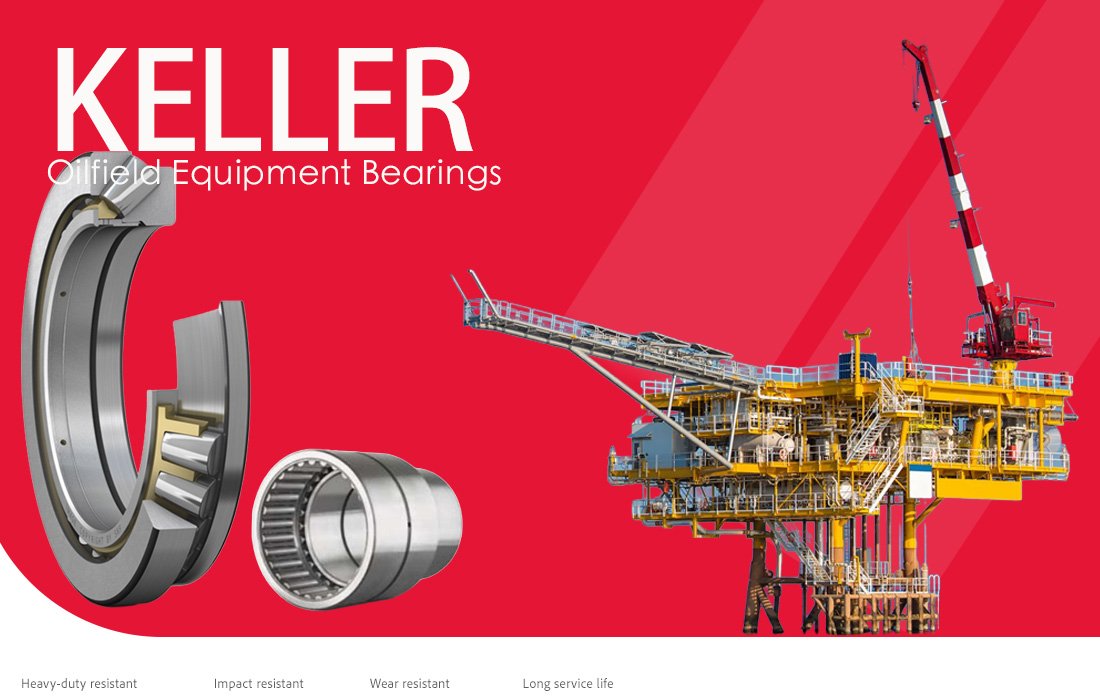
Oilfield equipment bearings are crucial basic components in oil drilling, oil and gas extraction, and related mechanical equipment. Compared to ordinary industrial equipment, oilfield equipment typically operates for extended periods under complex environments such as high loads, impact vibrations, high temperatures, and dust and mud, thus placing higher demands on the strength, wear resistance, and service life of bearings. In the bearing manufacturing process, heat treatment is one of the key factors determining bearing performance. Proper heat treatment can improve the internal structure of the bearing material, increasing hardness, wear resistance, and contact fatigue strength, thereby ensuring stable operation of the bearing under harsh conditions.
1. Improving Bearing Hardness and Wear Resistance
During operation, oilfield equipment bearings experience continuous contact and friction between the rolling elements and the raceways. If the bearing material lacks sufficient hardness, long-term operation can easily lead to wear, pitting, and even surface spalling.
Through heat treatment processes such as quenching and tempering, bearing steel can achieve suitable hardness and microstructure, improving the wear resistance of the raceways and rolling surfaces. Good Wear Resistance:For machinery subjected to heavy loads, such as drilling equipment and mud pumps, good wear resistance helps bearings maintain stable operation and reduces maintenance and replacement due to wear.
2. Improved Contact Fatigue Life:
Oilfield equipment bearings typically withstand continuous cyclic loads. After prolonged operation, fatigue cracks may develop on the raceway surface, gradually progressing to pitting or spalling, ultimately leading to bearing failure.
Heat treatment can improve the microstructure of bearing steel, giving the material a good combination of strength and toughness, and improving the contact fatigue resistance of the raceway surface. Especially for heavy-duty bearings, appropriate heat treatment parameters play a crucial role in extending bearing service life.
3. Improved Load-Bearing and Impact Resistance:
Oilfield drilling equipment and machinery frequently experience instantaneous impact loads and vibrations during operation. For example, when drilling equipment starts up, stops, or the load changes, bearings may withstand loads far exceeding normal operating conditions.
If the internal microstructure of the bearing material is uneven or the heat treatment quality is unstable, problems such as deformation and cracking may occur. Therefore, by rationally controlling processes such as heating, holding, quenching, and tempering, bearings can achieve more stable mechanical properties, improving their load-bearing capacity and impact resistance.
4. Controlling Bearing Dimensional Stability
Bearings are high-precision mechanical parts with high requirements for dimensional and geometric accuracy. Heat treatment generates structural transformations and internal stresses. If process control is inadequate, it can easily cause bearing ring deformation, affecting subsequent grinding and final assembly accuracy.
Therefore, the temperature, heating rate, holding time, and cooling method must be strictly controlled during the heat treatment of bearings for petroleum equipment. Some high-precision bearings also require combined tempering and stabilization treatments to reduce residual stress and improve dimensional stability.
5. Adapting to Complex Working Environments
Petroleum equipment is frequently used in workplaces with complex environmental conditions. In addition to bearing high mechanical loads, bearings may be affected by temperature changes, changes in lubrication conditions, and the ingress of contaminants.
Good heat treatment enables bearing materials to possess more stable overall properties, providing a reliable foundation for subsequent surface treatment, lubrication, and sealing design. For special operating conditions such as high temperature and high load, appropriate bearing steel and heat treatment schemes can be selected based on actual usage conditions.
6. Heat Treatment Quality Directly Affects Bearing Life
From raw materials to finished bearings, heat treatment is a crucial process connecting rough machining and precision machining. Excessive quenching temperature can lead to coarse grains; improper cooling rates or process parameters can generate excessive residual stress or even cracks. Insufficient hardness, on the other hand, reduces the bearing’s wear resistance.
Therefore, in the production of bearings for petroleum equipment, it is necessary to formulate appropriate heat treatment processes based on the material grade, bearing structure, dimensions, and actual operating conditions, and to conduct quality control through hardness testing, metallographic analysis, and dimensional inspection.
Summary
Overall, heat treatment is one of the key processes determining product performance and service life in the manufacturing of bearings for petroleum equipment. Through proper quenching, tempering, and related heat treatments, the internal structure of bearing steel can be improved, increasing hardness, wear resistance, contact fatigue strength, load-bearing capacity, and dimensional stability.
For oil drilling rigs, mud pumps, top drive systems, pumping equipment, and other oilfield machinery, selecting a heat treatment process that matches the actual operating conditions can help bearings maintain stable operation under high loads, impact vibrations, and complex environments. Therefore, professional heat treatment process control and rigorous quality testing are crucial guarantees for producing high-reliability oilfield equipment bearings.


