
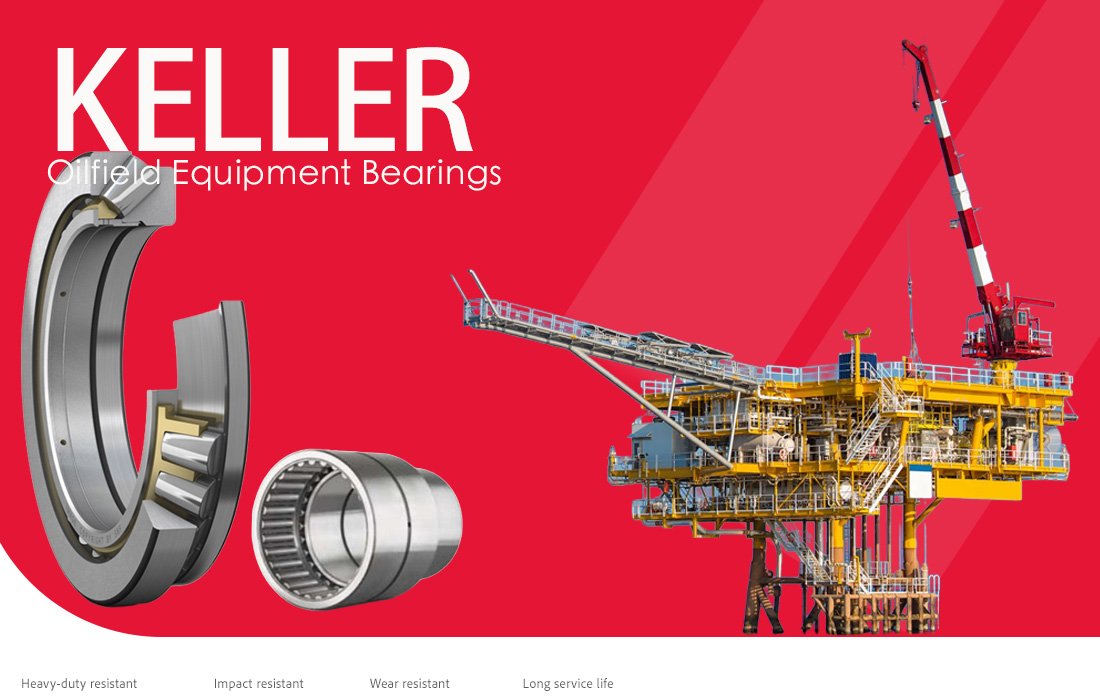
The precision grade of oil machinery bearings is an important indicator for measuring the dimensional accuracy, rotational accuracy, and operational stability of bearings. For machinery such as oil drilling equipment, mud pumps, top drive systems, and oil pumping equipment, bearings not only need to withstand large radial and axial loads but may also be subjected to complex operating conditions such as impact, vibration, and high temperatures for extended periods. Therefore, a correct understanding of bearing precision grades is crucial for bearing selection, equipment operating efficiency, and service life.
1. What is a Bearing Precision Grade?
The bearing precision grade primarily reflects the precision of the bearing components after machining and assembly. It typically includes indicators such as the dimensional accuracy, rotational accuracy, radial runout, axial runout, and dimensional deviations of the inner and outer rings.
According to common bearing precision standards, precision grades are generally divided into different levels such as ordinary, P6, P5, P4, and P2. The specific representation may differ between different standard systems; therefore, the actual purchase should be based on the product’s execution standard and the manufacturer’s technical parameters.
It is important to note that a higher precision grade does not necessarily mean a higher bearing load capacity. Precision primarily addresses the question of “how precise the machining and rotation are,” while load-bearing capacity is also related to factors such as bearing structure, materials, dimensions, number of rolling elements, heat treatment, and internal clearance.
2. Why is bearing precision important in petroleum machinery?
Petroleum machinery typically features long continuous operating times, heavy workloads, and complex working environments. Insufficient bearing precision can lead to significant vibration and noise during operation, while also affecting the fit between the shaft and bearing housing.
For example, in high-speed rotating top drive systems or drilling equipment, unstable bearing rotational precision can increase equipment vibration and further affect gears, shafts, seals, and other related components.
While heavy-duty equipment like mud pumps may not require the highest precision grade, they do need to maintain stable rotation while meeting load requirements. Therefore, bearing precision needs to be rationally selected based on the equipment structure and actual working conditions.
3. What are the differences between common precision grades?
Ordinary precision grades generally meet the needs of general industrial equipment, featuring relatively low cost and wide application range. For some low-speed, heavy-load petroleum machinery, if the equipment does not have special requirements for rotational accuracy, ordinary precision bearings may be a suitable choice.
P6 grade represents a higher precision class, superior to ordinary grades in both dimensional and rotational accuracy, and can be used in machinery requiring a certain level of operational stability.
P5 and P4 grades offer even higher machining and rotational accuracy, typically used in high-speed, high-precision equipment or equipment with stringent vibration control requirements.
As for P2 grade, it represents an even higher precision class, primarily used in specialized equipment with extremely stringent precision requirements, and is not necessary for all petroleum machinery.
Therefore, in actual selection, it is not simply a matter of “the higher the precision, the better,” but rather a comprehensive consideration of equipment speed, load, installation accuracy, temperature, lubrication conditions, and operating environment.
4. What is the difference between precision class and bearing clearance?
These are two easily confused concepts when selecting bearings for petroleum machinery.
Precision class primarily describes the precision of bearing machining and rotation; while internal clearance refers to the allowable relative movement clearance between the rolling elements and bearing races, whether the bearing is not installed or after installation.
For example, when oil machinery operates in high-temperature environments, the shaft and bearing inner ring may experience thermal expansion. If the clearance is not properly selected, it can lead to increased bearing operating temperature or even jamming. Therefore, even with high-precision bearings, inappropriate clearance selection cannot guarantee stable equipment operation.
5. How to Choose the Appropriate Precision Grade?
The precision grade of oil machinery bearings should be determined comprehensively based on speed, load, temperature, equipment structure, and installation requirements.
For ordinary low-speed, heavy-load equipment, standard precision bearings that meet the mechanical operation requirements can be prioritized; for high-speed rotating equipment, greater attention needs to be paid to rotational accuracy, vibration, and temperature rise; for precision oil equipment, higher precision grades such as P5 and P4 can be selected according to the equipment manufacturer’s requirements.
Furthermore, the fit accuracy between the bearing and the shaft/bearing housing is also crucial. Even if the bearing itself has high precision, insufficient machining accuracy of the mounting components can affect the final operating performance.
Summary
The precision grade of oil machinery bearings is mainly used to measure the dimensional and rotational accuracy of the bearing. Common grades include standard, P6, P5, P4, and P2. A higher precision grade generally means more precise bearing machining and rotational performance, but it does not necessarily mean a higher load-bearing capacity.
Therefore, when selecting bearings for equipment such as oil drilling rigs, mud pumps, top drive systems, and pumping units, the precision grade should be appropriately matched according to the actual working conditions, while comprehensively considering load-bearing capacity, rotational speed, internal clearance, materials, heat treatment, lubrication, and sealing structure. Only when all parameters are matched can the performance of oil machinery bearings be truly maximized, thereby improving the reliability and service life of the equipment.


