
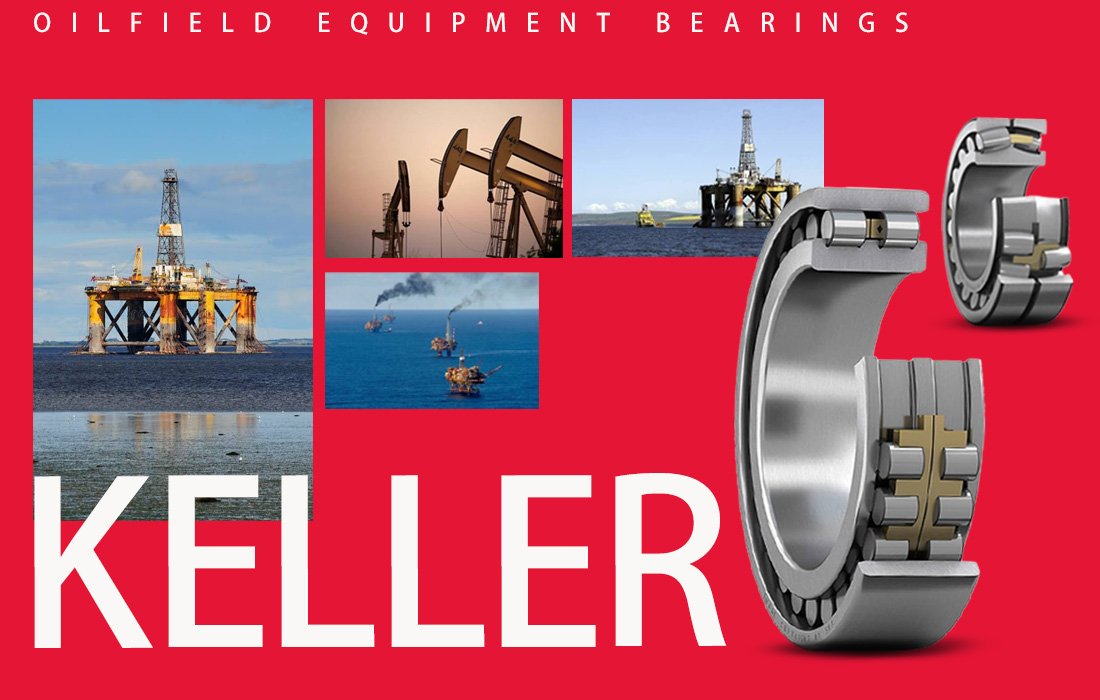
Oilfield machinery bearings are mainly used in oil drilling equipment, mud pumps, rotating equipment, top drive systems, pumping equipment, and other oil and gas machinery. Because oilfield machinery typically operates continuously under high loads, high temperatures, impact vibrations, and complex environments involving dust and mud, bearings must not only possess high load-bearing capacity but also excellent wear resistance, sealing properties, and service life. The manufacturing process generally includes multiple stages such as raw material preparation, forging, heat treatment, turning, grinding, assembly, and testing.
1. Raw Material Selection
The first step in manufacturing oilfield machinery bearings is selecting suitable bearing steel. Commonly used materials include high-carbon chromium bearing steels such as GCr15 and GCr15SiMn. For special operating conditions, special materials with high temperature resistance, corrosion resistance, or higher load-bearing capacity may be used according to customer requirements.
The chemical composition, purity, hardness, and internal structure of the raw materials directly affect the fatigue life of the bearing. Therefore, before production begins, the steel must undergo quality inspection to ensure that the materials meet relevant standards and technical requirements.
2. Forging and Forming
Inspected bearing steel typically requires blanking and forging. Forging improves the internal structure of the metal, giving the material more optimized fiber flow lines, thereby increasing the strength and impact resistance of the bearing rings.
Petroleum machinery bearings often bear large radial, axial, and impact loads, making the control of the forging process particularly important. After forging, annealing is required to prepare for subsequent machining.
3. Turning
Turning is mainly used to machine the basic dimensions and structure of the bearing’s inner and outer rings, including inner and outer diameters, end faces, and raceways. Modern bearing manufacturing typically uses CNC lathes for machining, which improves dimensional accuracy and production efficiency.
During this process, it is necessary to strictly control the machining allowance to leave reasonable machining dimensions for subsequent grinding processes. Simultaneously, parameters such as the roundness, coaxiality, and raceway position of the rings also require strict control.
4. Heat Treatment
Heat treatment is one of the key steps in the manufacturing process of petroleum machinery bearings. Common heat treatment processes include quenching and tempering, primarily aimed at improving the hardness, wear resistance, and contact fatigue strength of bearing rings.
During heat treatment, parameters such as heating temperature, holding time, and cooling rate must be strictly controlled. Improper heat treatment can lead to insufficient hardness, deformation, or even cracks, directly affecting the bearing’s service life. Therefore, hardness and metallographic structure testing are typically performed after heat treatment.
5. Grinding and Finishing
After heat treatment, the bearing rings undergo grinding to further improve dimensional accuracy and surface quality. This mainly includes external cylindrical grinding, internal cylindrical grinding, end face grinding, and raceway grinding.
For oilfield machinery bearings, the machining accuracy of the raceways and rolling surfaces is crucial. Good surface roughness and geometric accuracy reduce friction and heat generation, lower vibration and noise during operation, and improve bearing fatigue life.
6. Bearing Assembly
After precision machining, the inner ring, outer ring, rolling elements, and cage require cleaning, inspection, and assembly. During assembly, it is necessary to control the bearing’s clearance, rotational flexibility, and the fitting precision between various parts.
For petroleum machinery operating in harsh environments, special sealing structures, lubricants, or surface treatments may be used to improve the bearing’s dustproof, mudproof, and corrosion-resistant capabilities.
7. Finished Product Inspection
After bearing assembly, comprehensive quality inspection is required. Common inspection items include dimensional accuracy, rotational accuracy, radial clearance, hardness, surface roughness, vibration, noise, and appearance quality.
For high-requirement petroleum machinery bearings, performance tests such as load, temperature rise, and lifespan can be conducted according to actual operating conditions. Only after all indicators meet design and customer requirements can the product proceed to packaging and shipping.
Overall, the manufacturing process of petroleum machinery bearings is a complete process from materials, forging, heat treatment to precision machining, assembly, and inspection. Among these, material selection, heat treatment, and grinding precision have a significant impact on the bearing’s load-bearing capacity and service life. For different petroleum machinery and working environments, it is also necessary to make reasonable selections of bearing structure, materials, clearance, sealing methods and lubrication schemes to ensure that the bearings operate stably under high loads, impact vibrations and complex working conditions.


