
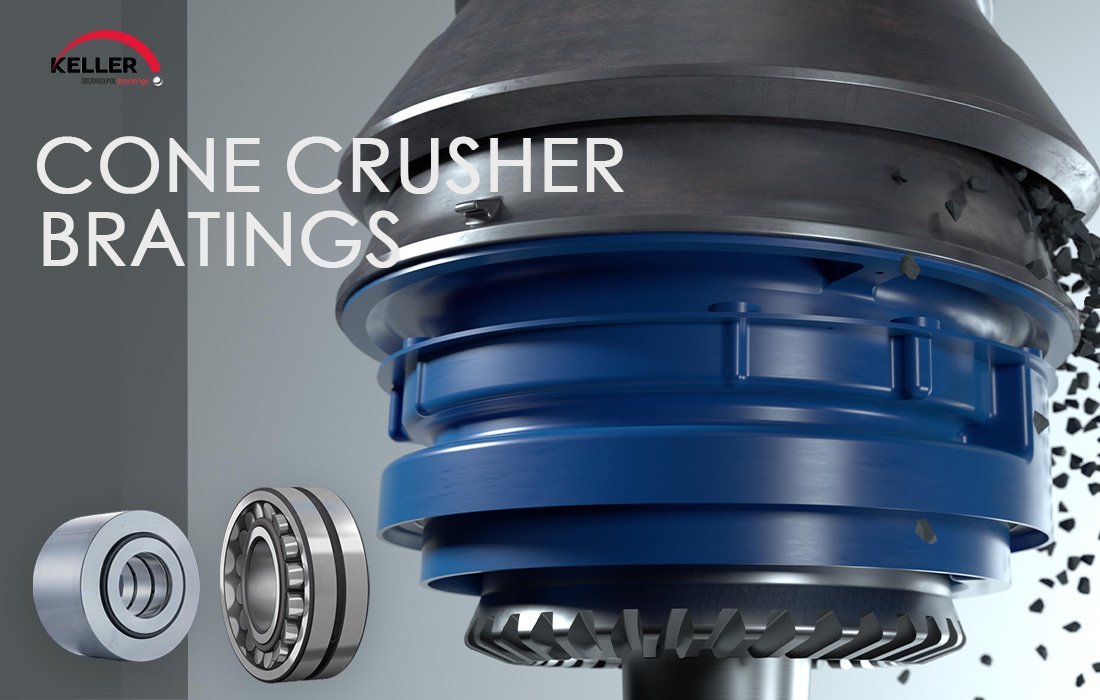
Cone crushers are widely used in industries such as mining, aggregate production, metallurgy, and construction. These machines crush materials through a combination of rotary motion and compressive force, requiring bearings to continuously support the main shaft and associated moving parts. Cone crusher bearings withstand significant loads and directly influence operational stability, crushing efficiency, and maintenance intervals.
The Role of Cone Crusher Bearings
During operation, the cone crusher’s main shaft rotates continuously—at either high or low speeds—while enduring impact loads generated by the material crushing process. Bearings must effectively support these forces and maintain stable alignment between moving components.
Furthermore, bearings serve to minimize friction between rotating parts. Optimal operating conditions reduce mechanical energy loss and help the equipment maintain appropriate working temperatures. Consequently, bearing performance directly impacts the cone crusher’s ability to operate continuously.
Demanding Operating Conditions Test Bearing Performance
Mining environments typically involve high levels of dust and particulate matter. Additionally, cone crushers process hard ores and rocks, subjecting the equipment to significant impacts during operation.
Therefore, cone crusher bearings require high load-bearing capacity and impact resistance. They must also exhibit excellent wear resistance to withstand prolonged, continuous operation.
In dusty work environments, proper bearing sealing and protection are crucial. Effective protective designs prevent external contaminants from entering the bearing assembly, thereby reducing the risk of wear.
Selecting the Right Cone Crusher Bearings
When selecting bearings, users must consider the specific model and operating parameters of the cone crusher. First, it is necessary to determine the radial and axial loads the bearing will endure, then select the appropriate specifications based on the equipment’s structural design.
Next, users must consider rotational speed and operating temperature. Different speeds generate varying levels of friction and heat, requiring a bearing structure and lubrication method that are well-suited to these conditions.
Finally, installation space is a key factor in bearing selection. Shaft diameter, housing dimensions, and mounting methods must all be taken into account. By comprehensively analyzing equipment loads, rotational speeds, temperatures, and installation conditions, users can optimize the compatibility between bearings and the cone crusher.
Lubrication Management Affects Operational Stability
Proper lubrication reduces friction from rolling contact and helps bearings manage operating temperatures. Personnel should establish appropriate lubrication intervals based on equipment operating conditions and select lubricants suited to the working environment.
Additionally, the lubrication status must be checked regularly. If the grease shows signs of significant contamination, deterioration, or insufficiency, corrective measures should be taken promptly.
Personnel can also assess bearing performance by monitoring equipment noise, vibration, and temperature. Any abnormal changes should trigger an immediate inspection of relevant components to prevent minor issues from escalating.
Proper Installation Reduces Operational Risks
The quality of bearing installation directly impacts the performance of cone crushers. During installation, it is crucial to maintain precise fits between the bearing, the shaft, and the housing.
Care must be taken to avoid striking critical areas such as the rolling elements and raceways. After installation, the bearing’s rotational smoothness and the integrity of connections should be verified.
Proper installation minimizes uneven loading, abnormal wear, and operational vibration, thereby helping bearings maintain stable operating conditions.
Cone Crusher Bearings Enable Efficient Crushing
As mining equipment trends toward larger sizes and higher efficiency, cone crushers place greater demands on bearings. Bearings must withstand heavy loads, impacts, and continuous rotation over long periods while operating in environments with high dust levels.
Therefore, users should make informed choices regarding cone crusher bearings based on actual operating conditions. Furthermore, proper installation, appropriate lubrication, and regular inspections help ensure consistent bearing performance.
The effective application of bearing technology not only enhances the operational stability of cone crushers but also reduces unplanned downtime, providing reliable support for continuous crushing operations. :::


