
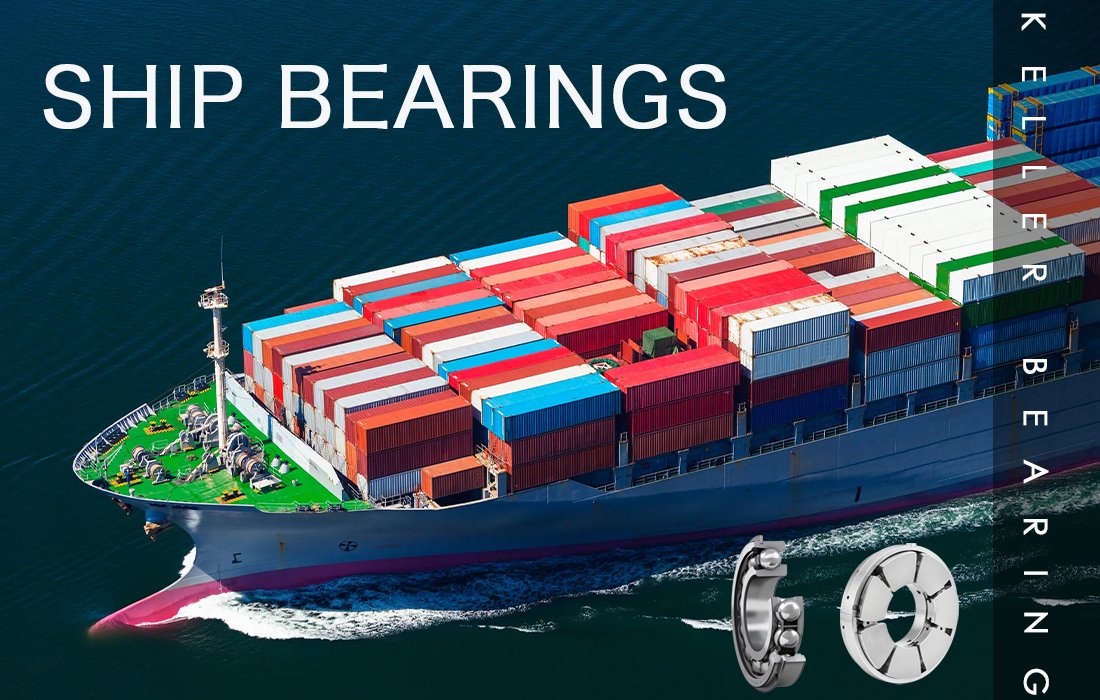
Marine bearings are critical components of a ship’s propulsion and transmission systems. They primarily serve to support rotating parts, minimize friction, and ensure the stable operation of equipment. During long voyages, these bearings must withstand heavy loads, continuous vibration, and the effects of the harsh marine environment.
Different types of vessels have varying bearing requirements. Common marine bearings include thrust bearings, stern bearings, intermediate bearings, sliding bearings, and rolling bearings. These are utilized in propulsion systems, main engines, and auxiliary machinery.
Thrust Bearings
Thrust bearings are primarily designed to withstand the axial forces generated by the ship’s propulsion system. As the propeller rotates, it generates the thrust that drives the vessel forward. Thrust bearings transmit these axial loads and maintain the stability of the shafting system.
Large vessels typically employ tilting-pad thrust bearings. These bearings offer high load-bearing capacity and excellent operational stability, effectively reducing frictional losses and enhancing the efficiency of the propulsion system.
Stern Bearings
Stern bearings (also known as tail bearings) are installed at the ship’s stern to support the propeller shaft. Due to constant exposure to the marine environment, they require excellent wear and corrosion resistance.
Common types include water-lubricated stern bearings, rubber bearings, and composite material bearings. Water-lubricated designs utilize seawater for lubrication, thereby reducing environmental pollution and aligning with modern trends toward energy conservation and environmental protection in shipbuilding.
Intermediate Bearings
Intermediate bearings are primarily used to support long transmission shafting systems. The propulsion shafts of large vessels are often very long; without effective support, they are prone to vibration and shaft misalignment.
Intermediate bearings enhance the operational stability of the shafting system and reduce equipment wear. They are widely used in container ships, bulk carriers, oil tankers, and offshore engineering vessels.
Sliding Bearings
Sliding bearings provide support through the sliding motion between the shaft and the bearing surface. They are characterized by high load-bearing capacity, smooth operation, and suitability for heavy-load environments. Plain bearings are widely used in marine main engines, propulsion systems, and large-scale mechanical equipment. Common types include Babbitt alloy bearings, copper alloy bearings, and composite material plain bearings.
Rolling Bearings
Rolling bearings are primarily used in marine auxiliary equipment, such as generators, electric motors, water pumps, and fans.
Common types of rolling bearings include deep-groove ball bearings, cylindrical roller bearings, tapered roller bearings, and spherical roller bearings. Rolling bearings are characterized by low starting resistance, high operating efficiency, and ease of maintenance.
Operational Characteristics of Marine Bearings
Marine bearings must meet a variety of operational requirements. First, they require high load-bearing capacity to withstand the stresses generated by the long-term operation of marine equipment.
Second, given that ships operate in seawater environments, bearing materials must possess excellent corrosion resistance. At the same time, low-friction designs help reduce energy loss and improve the vessel’s operating efficiency.
Furthermore, marine bearings need to have a long service life to ensure stable operation during long-distance ocean voyages.
Development Trends in Marine Bearings
As the modern shipping industry evolves, marine bearing technology continues to advance. Water-lubricated bearings, composite material bearings, and low-friction designs are increasingly gaining attention.
In the future, marine bearings will place greater emphasis on environmental performance, operating efficiency, and reliability, providing more stable support for ship propulsion systems.
Although marine bearings are small components within a vessel’s equipment, they play a crucial role in overall operational safety. Understanding the characteristics of different types of marine bearings helps provide better insight into the operation of ship propulsion systems.


