
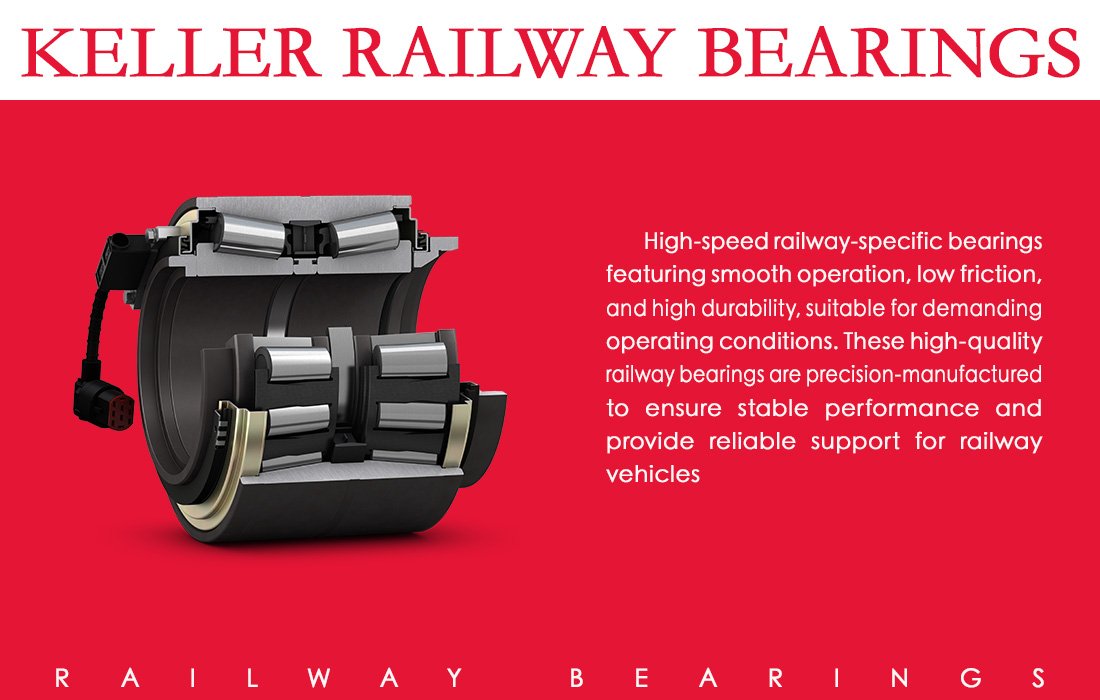
Railway bearings are critical components of railway rolling stock. While locomotives, passenger cars, and freight wagons all require bearings, their operational characteristics differ significantly, leading to distinct application requirements.Bearings must support axles and wheelsets while withstanding operational loads. Different vehicle types impose varying demands regarding load-bearing capacity, speed performance, and durability.
Railway Bearing Applications in Locomotives
Locomotives are responsible for traction and must generate substantial tractive force; consequently, their bearings often endure high loads.
Both electric and diesel-electric locomotives utilize various types of railway bearings, including axle bearings, axle-box bearings, traction motor bearings, and gearbox bearings.Locomotives operate for extended periods, requiring bearings to maintain stable operating temperatures. High-quality materials and effective lubrication strategies are essential to minimize friction and wear.Traction motor bearings must also accommodate high rotational speeds. Some motor systems require insulated bearings, a design feature that mitigates bearing damage caused by electric currents.
Railway Bearing Applications in Passenger Cars
Passenger cars are primarily used for transporting passengers, placing a premium on operational smoothness and ride comfort.Axle-box bearings in passenger cars support the wheelsets while helping to minimize operational vibration and noise. High bearing precision contributes to smooth vehicle operation.High-speed passenger trains and electric multiple units (EMUs) impose more rigorous demands on bearings. Due to high operating speeds, bearings must exhibit excellent high-speed performance and thermal stability.Sealing performance is also critical. As passenger cars operate across diverse weather conditions, reliable sealing structures are necessary to prevent the ingress of dust and moisture into the bearings.
Railway Bearing Applications in Freight Wagons
Freight wagons are primarily used to transport commodities such as coal, ore, and steel. These wagons typically endure heavy loads.Consequently, bearings for freight wagons prioritize load-bearing capacity and durability. They must withstand substantial radial loads over long periods while also enduring the shocks and vibrations generated by the railway track.Although freight wagons generally operate at lower speeds than high-speed passenger trains, some freight trains cover long distances; therefore, the bearings must still demonstrate excellent wear resistance. Freight car bearings must also adapt to diverse environments. Mining areas, ports, and industrial transport routes often involve high levels of dust, requiring bearings to feature reliable sealing structures.
Key Differences Between the Three Types of Railway Vehicle Bearings
Locomotive bearings prioritize traction loads, operating duration, and power system requirements. Passenger car bearings focus more on high-speed performance, low noise levels, and passenger comfort. Freight car bearings emphasize heavy-load capacity, wear resistance, and impact resistance.
Purchasers must select bearings based on the specific vehicle type. Factors such as the vehicle model, axle dimensions, operating speed, and load requirements all influence the selection process.
Railway bearing suppliers are required to provide detailed product specifications. Common parameters include the bearing model, dimensions, materials, precision grade, and compatible vehicle types.
The International Market for Railway Bearings
The global railway transport market continues to grow, with steady demand across various countries for bearings used in locomotives, passenger cars, and freight cars.Overseas buyers typically prioritize product quality, technical specifications, and delivery capabilities. Professional suppliers need to provide clear product documentation. Proper export packaging also helps minimize risks during transit.Selecting the right railway bearings enhances vehicle operational stability, reduces maintenance costs, and extends the service life of critical vehicle components.
Conclusion
While locomotives, passenger cars, and freight cars all utilize railway bearings, their operational priorities differ. Locomotives emphasize power and load-bearing capacity; passenger cars prioritize high-speed performance and comfort; and freight cars focus on heavy-load handling and durability.
Specialized railway bearing manufacturers must offer products tailored to specific vehicle types. Through precision manufacturing, rigorous testing, and appropriate lubrication, companies can deliver reliable bearing solutions to railway customers worldwide.


