
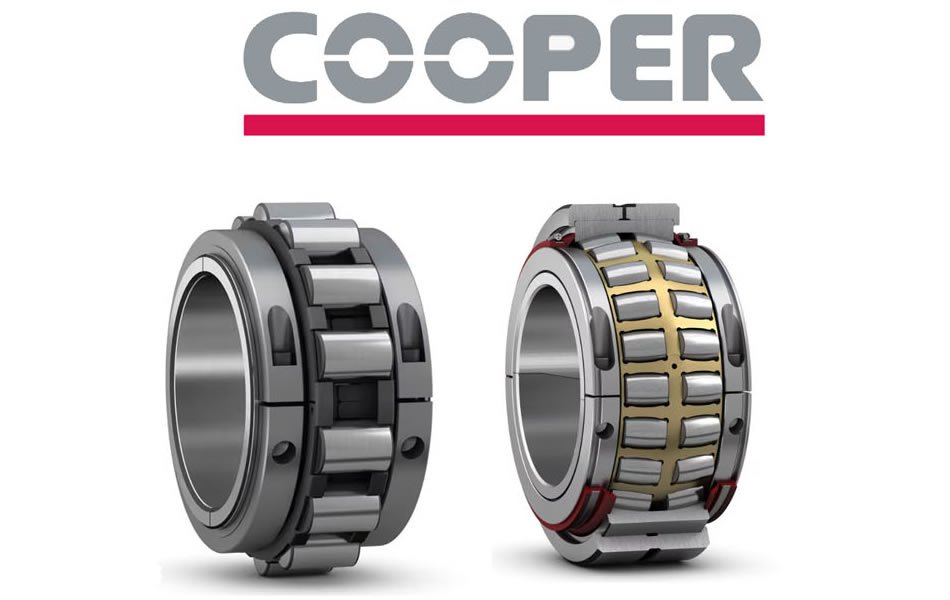
The SKF Cooper split spherical roller bearing can help to reduce the contamination that works its way into open pulley bearings. Its split design means that bearings can be replaced in-situ, which reduces downtime, maintenance costs and risks to worker safety. A sealed variant reduces the need for excess lubrication and protects against contamination.
The initial range is the 231 series, which has metric shaft diameters of 240 to 450mm (corresponding to inch shaft diameters of 9.5 to 18 inch). These bearings can interchange with standard 23152 K to 23192 K spherical roller bearings mounted on adapter sleeves in split block housings.
The bearing comprises inner and outer rings, cage and rollers, outer shroud and two inner clamp rings, with screws to bolt the shrouds and clamp rings together. Seals are optional.
A key feature that helps these bearings improve performance and service life is the design of the rings. Both inner and outer rings are wire-cut to minimise discontinuities. This improves clamping and alignment accuracy of both halves of the ring. The interlocking outer race and shroud joints create good alignment between the two halves and reduce the risk of damage at the splits during operation. The wire-cut angular inner race joints further enhance smoothness of the roller path.
Using wire cutting, rather than fractured rings, to split the rings also reduces the risk of fretting corrosion with the shaft. Finally, the steel clamp rings allow permissible axial loads (shaft clamping) up to twice that of comparable split spherical bearings. At the same time, running noise levels are reduced.
The bearing can be fitted in all SKF metric (SNL, SNLD) and inch (SAF, SAFD, SDAF) split plummer block housings. The split bearing outer ring is the same size as a standard spherical roller bearing. It can fit into split plummer block housings with standard locating rings if needed. The shaft requirements of the split bearing are identical to those of a standard spherical bearing mounted on an adapter sleeve (ISO h9 shaft diameter tolerance and IT5 form).
Overall, there are several key benefits of this type of ring design. They include: better shaft clamping; less shaft looseness; lower risk of shaft fretting; reduced noise levels; and higher permissible loads than comparable products.
The main application is in the trapped bearing position of the machine. Here, the replacement with a standard (non-split) bearing would require removal, via hoisting, of the gearbox and drive coupling.
With this new solution, the procedure to replace a bearing in the trapped position requires fewer steps. For example, the bearings require no changes to the shaft alignment or driveline and there is no need to dismount the drive coupling or cantilevered drive. This reduces the need to rent equipment such as cranes and alignment tools.
Moving the conveyor belt to access the pulley, while moving the pulley and gearbox, can be very dangerous, as they are heavy and elevated above the ground. This increases the risk of injuries. In-situ replacement with a split bearing only requires a slight raising of the shaft and little or no disturbance to the drive coupling or gearbox, helping to reduce worker exposure to safety hazards.
Sealed split spherical roller bearings have more than double the service life of their unsealed equivalents. In just one example, the L10mh rating life of the seal bearing is 2.9 times that of an open (unsealed) bearing.
Keeping the lubricant enclosed within a tight seal also means that far less grease is consumed. Using a sealed split bearing can reduce the need for lubrication by as much as 95%, resulting in reduced costs, reduced safety risks and reduced environmental impact.
Improving machinery reliability and maintainability can also lead to increased productivity and availability. The split design of these units helps to make bearing replacement in the trapped position faster and safer. They also enjoy longer service life and better performance than comparable products due to the wire cut inner and outer ring manufacturing technique and seals.
Overall, sealed split spherical roller bearings can help reduce maintenance costs and production losses, improve worker safety and reduce environmental impact. They are interchangeable with competitive split spherical roller bearings, and compatible with SKF’s metric and inch split plummer block housings.
Raising productivity in a large, complex industry such as mining or cement production is a multi-faceted task. Long-term, it requires operators to embrace innovation and to make greater use of analytical tools. However, fixes at a component level, such as specifying bearings that are easier to replace, can play their part in raising productivity as a whole in the shorter-term.


