
Origin of Split Bearings
As industrial equipment continues to develop towards larger, heavier, and continuous operation, traditional integral bearings have gradually revealed problems such as complex disassembly and assembly, long downtime, and high maintenance costs during installation and maintenance. Especially in industries such as mining, metallurgy, railways, power, and papermaking, the shaft systems of many devices cannot be disassembled as a whole. Replacing ordinary bearings often requires dismantling couplings, gears, motors, or even the entire transmission system, consuming a significant amount of manpower and time.
To solve this problem, split bearings emerged. In the mid-to-late 20th century, industrialized countries in Europe and America were the first to apply split design to large rolling bearings, enabling the installation and replacement of bearings without disassembling the shaft system. Through continuous optimization, split bearings have become an important product for the inspection and maintenance of large industrial equipment and are widely used in the global heavy industry sector.
Definition of Split Bearings
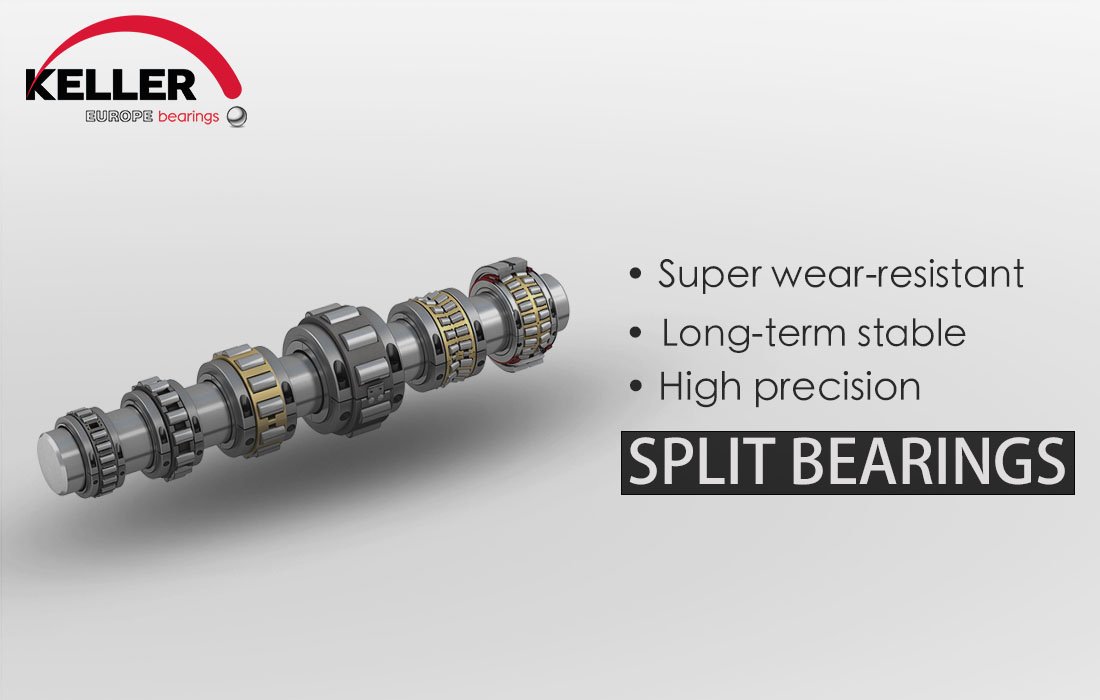
Split bearings, also known as split-type bearings, are a type of rolling bearing with a split structure design. Its inner ring, outer ring, cage, and rolling elements can be axially divided into two or more halves, assembled into a complete bearing using a high-precision positioning structure and fasteners.
Compared to traditional integral bearings, the biggest advantage of split bearings is that they do not require installation from the shaft end. They can be assembled and disassembled directly around the shaft, avoiding the removal of the shaft system and surrounding equipment, significantly reducing maintenance difficulty and improving equipment operating efficiency.fi
Product Features
Split bearings combine the load-bearing capacity of ordinary rolling bearings with the maintenance advantages of a split structure. Key features include:
- Shaft-free installation: Bearings can be installed and replaced without disassembling couplings, gears, motors, etc.
- Quick installation: Convenient on-site assembly, significantly reducing maintenance time.
- High load-bearing capacity: Can withstand large radial loads and a certain amount of axial load.
- Stable operation: High machining precision, smooth operation, low vibration and noise.
- Low maintenance costs: Reduces downtime and lowers labor and maintenance costs.
- Good interchangeability: Standardized design facilitates maintenance and spare parts management.
Models and Parameters
Currently, split bearings on the market mainly include split self-aligning roller bearings, split cylindrical roller bearings, and split ball bearings, among which split self-aligning roller bearings are the most widely used.
Common models include:
- Cooper 01, 02, 03 series
- SD series split bearings
- SRB series split self-aligning roller bearings
- 231, 232 series split self-aligning roller bearings
- Custom non-standard split bearings
Typical parameter range:
- Inner diameter: 40 mm~1000 mm and above
- Outer diameter: 80 mm~1500 mm and above
- Cage: Steel cage, brass cage
- Material: High carbon chromium bearing steel (GCr15), carburized steel, etc.
- Precision grade: P0, P6, P5, etc.
- Operating temperature: Approximately -30℃~200℃ (depending on lubrication method and material configuration)
Custom non-standard bearings can also be made according to customer equipment size and operating conditions.
Performance Advantages
Compared to traditional integral bearings, split bearings offer significant advantages:First, high maintenance efficiency. Bearings can be replaced without disassembling the entire transmission system, reducing maintenance time from days to hours.Second, minimal downtime losses. For continuous production industries such as steel, power, cement, and railways, every hour of reduced downtime translates into greater economic benefits.Third, adaptability to complex operating conditions. Split bearings can operate for extended periods in harsh environments with high loads, low speeds, medium to high speeds, and high dust levels, exhibiting high reliability and long service life.Furthermore, their excellent interchangeability and modular design make equipment maintenance more standardized and convenient.
Application Scenarios and Typical Equipment
- Railway Industry: Track maintenance equipment, vehicle inspection equipment, wheelset processing equipment, turnout maintenance equipment, etc.
- Metallurgical Industry: Rolling mills, continuous casting machines, sintering equipment, fans, etc.
- Mining Industry: Crushere, vibrating screens, belt conveyors, ball mills, etc.
- Power Industry: Exhaust fans, forced fans, circulating water pumps, generator auxiliary equipment, etc.
- Cement Industry: Rotary kilns, elevators, conveying equipment, etc.
- Paper Industry: Press rolls, drying cylinders, drive rolls, etc.
For example, 232 series split self-aligning roller bearings can be used in large belt conveyors; SD series split bearings can be used in industrial fans and blowers; and SRB series split self-aligning roller bearings are commonly used in railway maintenance equipment and heavy-duty transmission devices, effectively shortening equipment maintenance cycles and improving operational reliability.
The Value and Significance of Split Bearings
With the development of intelligent manufacturing and industrial equipment upgrades, equipment operating efficiency and maintenance costs have become important indicators for enterprises. Split bearings not only solve the problems of difficult installation and complex maintenance of traditional bearings, but also promote the transformation of equipment maintenance methods from “passive maintenance” to “efficient maintenance.”
In the future, with the continued development of industries such as railway equipment, intelligent manufacturing, mining machinery, new energy, power, and high-end equipment manufacturing, split bearings will play an increasingly important role in improving equipment reliability, reducing maintenance costs, and ensuring continuous production. It is not only an innovative bearing product, but also a crucial component of modern industry for achieving efficient, safe, and green operation and maintenance, providing solid support for the high-quality development of the equipment manufacturing industry.


