
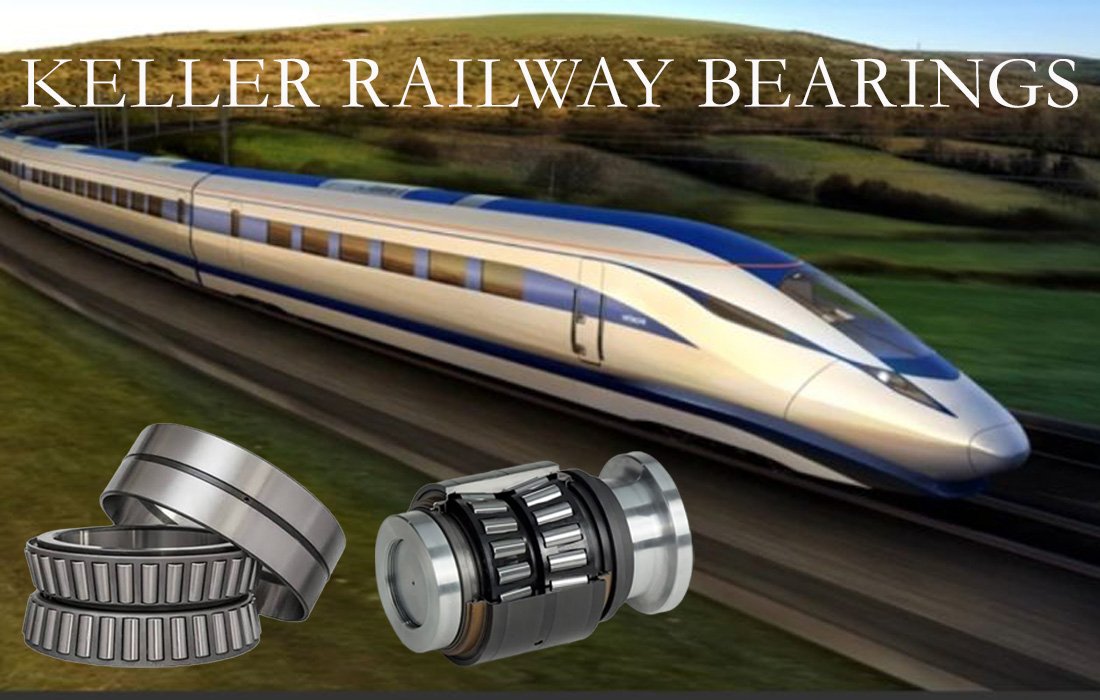
Railway bearings are critical components of railway vehicles. They primarily support the axle and rotating parts while reducing friction and vibration; consequently, they directly influence the operational stability of the train.Different railway vehicles have varying requirements, leading to a wide range of bearing types. They can be classified based on installation location, structure, and application.
1. Railway Axle Box Bearings
Axle box bearings are installed inside the axle box. They primarily support the axle and wheelset, meaning they must bear the weight of the vehicle.Additionally, axle box bearings must withstand operational shocks and vibrations, requiring excellent load-bearing capacity and wear resistance.High-speed electric multiple units (EMUs) place stricter demands on axle box bearings, which must also maintain a low temperature rise during operation. Therefore, high-precision bearings are typically used in high-speed rail applications.
2. Railway Wheelset Bearings
Wheelset bearings are primarily used in the wheel and axle system. They facilitate stable rotation of the wheelset while reducing operational friction.Wheelsets are subjected to significant loads during vehicle operation; thus, the bearings require high impact resistance.Furthermore, railway tracks generate loads from various directions, so the bearings must maintain good operational stability.
3. Railway Bogie Bearings
Bogie bearings are used in railway vehicle bogies. They support relevant rotating components while reducing friction and vibration.
EMUs and high-speed trains have high requirements for bogie bearings, necessitating excellent precision and durability.
4. Railway Traction Motor Bearings
Traction motor bearings are installed inside the motor to support the motor shaft and must accommodate high-speed rotation.Additionally, as motor operation generates heat, the bearings require good temperature resistance.Some traction motors require insulated bearings. Insulation structures reduce bearing damage caused by shaft currents; consequently, these bearings are commonly used in electric locomotives and EMUs.
5. Railway Gearbox Bearings
Gearbox bearings primarily support the gear shaft and must withstand the loads generated by gear meshing.At the same time, these bearings must maintain high rotational precision. Consequently, it helps the gearbox maintain stable power transmission.Both cylindrical roller bearings and tapered roller bearings can be used in certain gearboxes. The specific choice depends on factors such as load, rotational speed, and available structural space.
6. Railway Cylindrical Roller Bearings
Cylindrical roller bearings possess high radial load-carrying capacity, making them suitable for heavy-duty railway equipment.Additionally, they offer excellent high-speed performance, leading to their use in various railway vehicles and transmission systems.
7. Railway Tapered Roller Bearings
Tapered roller bearings can accommodate both radial and axial loads, making them suitable for complex loading conditions.They are used in railway freight cars and certain transmission systems, and are ideal for applications requiring high load-carrying capacity.
8. Railway Insulated Bearings
Railway insulated bearings are primarily used in equipment such as traction motors. They serve to minimize the flow of shaft current through the bearing.As a result, insulated bearings reduce the risk of electrical erosion and help extend the bearing’s service life.
How to Choose the Right Railway Bearing?
Different applications require different bearings; therefore, purchasers must consider several factors.First, the vehicle type must be identified. Second, the bearing’s installation location must be understood. Additionally, parameters such as load, rotational speed, and operating temperature must be confirmed.Sealing performance and lubrication methods are also critical. Professional railway bearing suppliers can provide selection recommendations based on the customer’s specific operating conditions.
Conclusion
There is a wide variety of railway bearings. Common types include axle box bearings, wheelset bearings, bogie bearings, traction motor bearings, and gearbox bearings.Cylindrical roller bearings, tapered roller bearings, and insulated bearings also see widespread use. Selecting the appropriate bearing enhances the operational stability of railway vehicles.As global railway transportation continues to develop, the demand for high-performance railway bearings in overseas markets is expected to grow steadily.


